BOS vs CHoCH Rules: Stay on the Right Side of Trend
Most traders can recite the definitions: BOS is a break of structure, CHoCH is a change of character. Yet their charts are still a mess of contradictory labels — bullish BOS printed inside a downtrend, CHoCH marked on every minor pullback, bias flipping every few candles. The problem is rarely the definitions. It's the rules for applying them. This guide covers the mechanical rules that make BOS and CHoCH actually useful: which structure counts, what confirms a break, and where a valid CHoCH must come from.
The only three things a market can do
Before any label, read the trend. A market is always in one of three states:
- Uptrend: a sequence of Higher Highs (HH) and Higher Lows (HL).
- Downtrend: a sequence of Lower Highs (LH) and Lower Lows (LL).
- Consolidation: price moving sideways with no clear sequence.
BOS and CHoCH only make sense inside this context. The same price break can be a BOS in one trend and a CHoCH in another — context decides the label, never the other way around.
Rule 1: Only external structure gives you bias
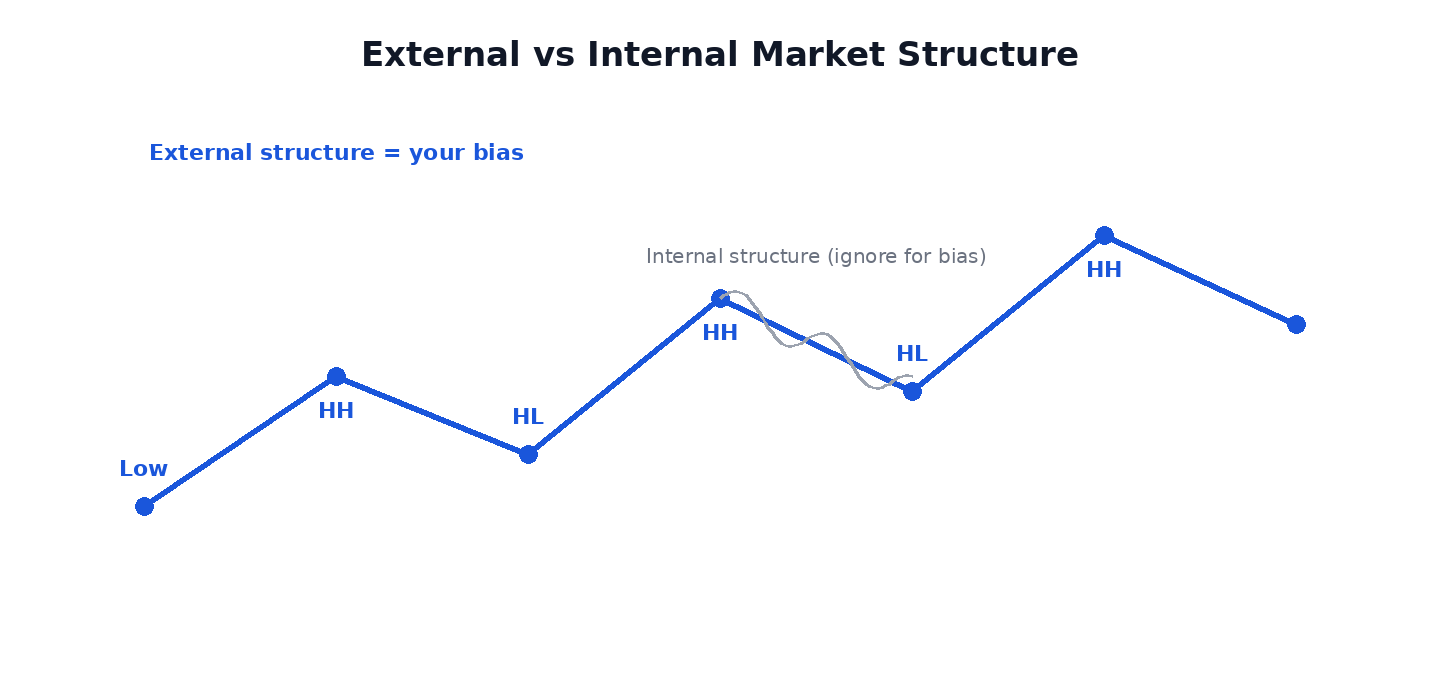
On any timeframe, there are two layers of structure. External structure is the structure of that timeframe — on the hourly chart, the hourly highs and lows. Internal structure is the smaller noise inside each leg — the 5-minute or 15-minute wiggles within an hourly trend.
The rule is strict: only external highs and lows give you directional bias on that timeframe. The internal swings in the middle are noise for bias purposes. Marking a CHoCH on an internal swing is the single most common way traders flip their bias too early and get run over by the real trend.
Rule 2: Pick one timeframe and stay in your lane
Trying to map the highs and lows of every timeframe at once creates an endless loop. A market can be in an uptrend on the hourly while printing a downtrend on the 5-minute inside a single pullback — both are "true," and chasing both will drive you crazy.
Pick one timeframe for your structure read and commit to it. The hourly is a solid starting point: enough opportunities per week with manageable noise. The 30-minute works too; the 4-hour is fine but slower. Avoid the 5-minute while learning — the noise makes it nearly impossible to define external structure cleanly. You can always use a lower timeframe later to refine entries, but your bias comes from one chart.
Rule 3: BOS means continuation, CHoCH means reversal
The names confuse beginners, so be explicit:
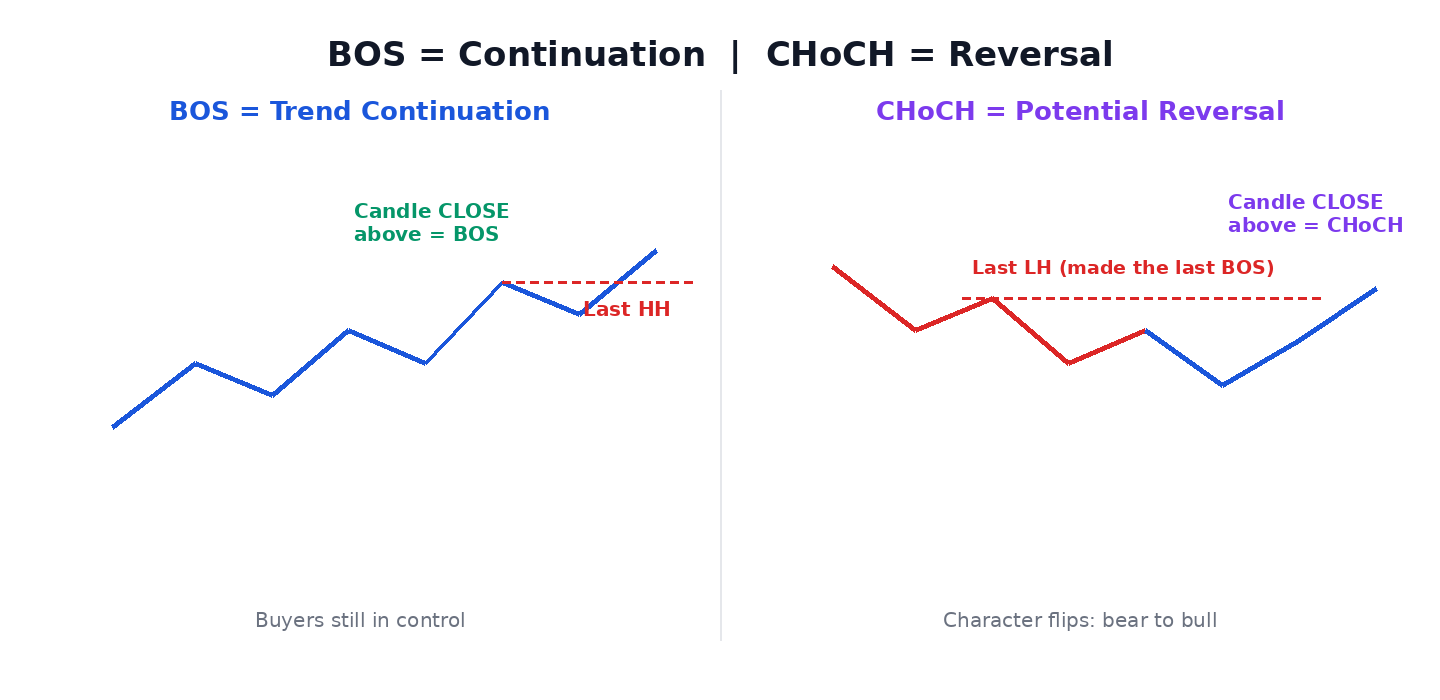
- BOS (Break of Structure) = trend continuation. When price closes beyond the last high in an uptrend (or the last low in a downtrend), it means buyers — or sellers — remain in control. The trend is intact.
- CHoCH (Change of Character) = potential trend reversal. There are two "characters" in the market: bull and bear. A change of character is literally the market switching from one to the other.
In a downtrend, draw your levels off the highs — those are the levels sellers must defend. As long as bearish BOS keeps printing, sellers are in control. After each BOS, move your level: the new extreme becomes the line to watch.
Rule 4: A break needs a candle close — wicks don't count
This rule is non-negotiable: a BOS or CHoCH requires a candle close beyond the level on the timeframe you're reading. An hourly close above the high on the hourly chart. A wick that pierces the level and closes back inside is not a break — it's more likely a liquidity sweep, which often means the opposite.
Price will test levels repeatedly. It may wick above a high twice and still not break it. Only the close confirms. If you label wicks as breaks, you'll manufacture BOS and CHoCH signals that never existed.
Rule 5: A CHoCH must come from the swing that made the last BOS
This is the rule that separates clean charts from chaos. A valid change of character must originate from the last high or low that produced the last break of structure. Trace it back: find the last BOS → find the swing that triggered it → that level is the one price must break for a genuine CHoCH.
Why it matters: every trend contains smaller internal swings. If you mark your CHoCH level on an internal high, price will "break" it constantly while the real trend continues — false reversal after false reversal. Only the external level that produced the last BOS qualifies.
One nuance worth knowing: a CHoCH preceded by a lower high (in an uptrend) or a higher low (in a downtrend) tends to be a stronger reversal signal — the market is already showing weakness before the break. Not required, but worth noting.
Rule 6: BOS and CHoCH are not entry signals
These labels tell you who is in control — nothing more. They are not key levels and not breakout entries. In most cases, after an impulsive break, price retraces into discount or tags the inefficiencies left behind during the move before continuing. Buying the break itself gets traders in trouble far more often than it pays.
Use BOS to confirm the trend is alive, use CHoCH to stop trading the old direction — then wait for price to come back to a level worth trading. For the full picture on entries, see our IDM guide and premium vs discount guide.
Rule 7: After a CHoCH, trade only the new direction
The entire point of this method is staying on the right side of the market. After a bullish CHoCH, look for buys only — stop shorting. After a bearish CHoCH, look for shorts only — stop buying. If you were positioned the old way, a confirmed CHoCH is your signal to step aside.
And define your pullbacks honestly: a valid pullback needs at least 3–5 consecutive candles pulling back against the move. A one- or two-candle dip is too shallow to mark structure from — using it gives you fragile levels that break on noise. When two candidate levels exist, prefer the more conservative (more extreme) one: it demands stronger confirmation and filters out weak breaks.
The checklist
- Read the trend first: HH/HL, LH/LL, or sideways.
- Mark external structure only — ignore internal noise for bias.
- Use one timeframe (hourly is a good start; skip the 5-minute while learning).
- BOS = continuation, CHoCH = reversal.
- Require a candle close beyond the level; wicks don't count.
- A CHoCH must break the swing that produced the last BOS.
- Never trade the break itself — wait for the retrace.
- After a CHoCH, trade only the new direction.
None of these rules is complicated on its own. Together, applied the same way every time, they turn BOS and CHoCH from decoration into a mechanical read on who's in control. The hard part is marking every swing consistently without missing breaks or labeling noise — which is exactly the kind of mechanical work software does well.
Stop Drawing Structure by Hand
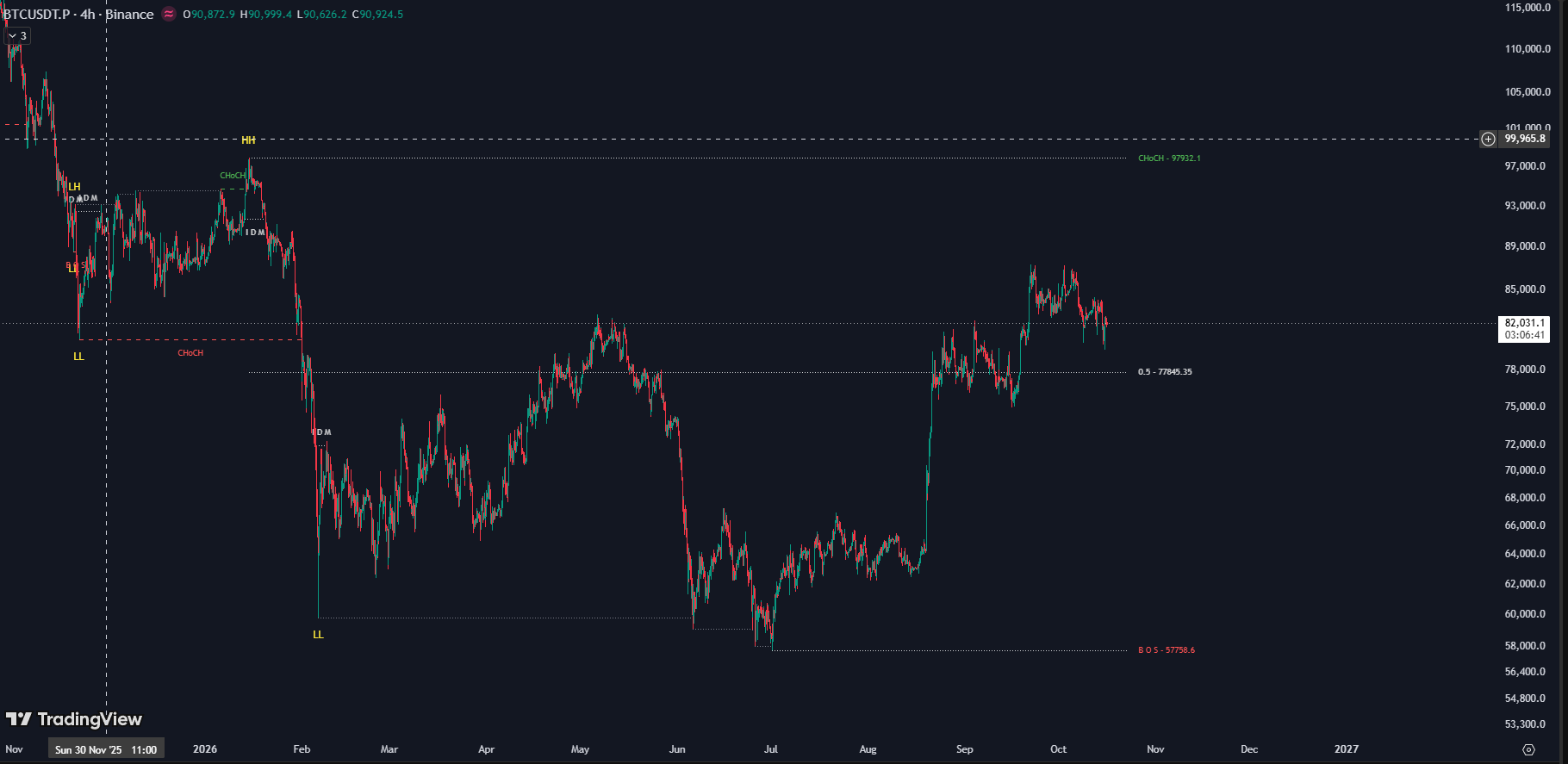
This is JUKA live on BTC 4H — every swing, BOS, CHoCH, IDM, and the premium/discount equilibrium labeled automatically, in real time.
No missed breaks. No mislabeled noise. No hours of hand-drawing. Full Pine Script v5 source code — yours to own forever, $150 one-time.
Get JUKA Source Code — $150