Trading Hub 3.0 (Part 10): Trading with Single Candle Order Block (SCOB) – SMC
This article will explain to readers how to identify a Single Candle Order Block and which factors you should follow to mark a Single Candle OB.
What is a Single Candle Order Block in SMC?
A Single Candle Order Block (SCOB) is a candle that forms at a Pullback / POI / IDM at the HTF or LTF, and the next candle after it closes above it (if bullish) or below it (if bearish). When a SCOB appears, wait for price to pull back to look for an entry at the LTF.
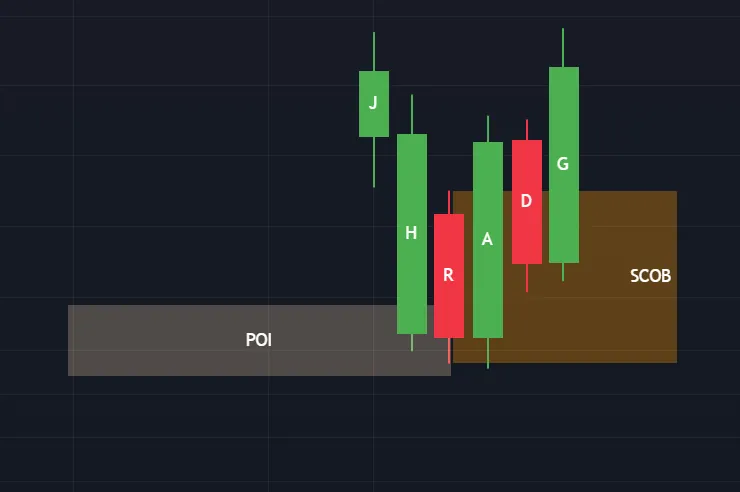 SCOB appears at a POI
 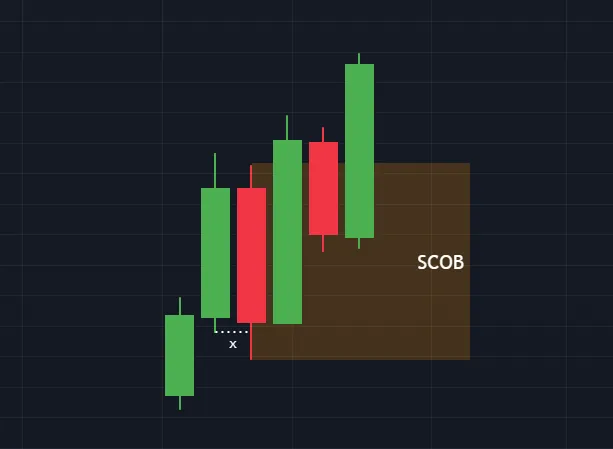 SCOB appears at a pullback
 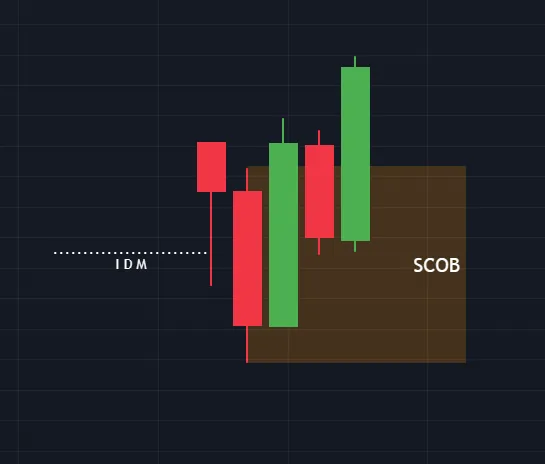 SCOB appears at IDM Cases where SCOB appears
If the SCOB also sweeps the liquidity of the previous candle, we can switch to the LTF and wait for price to pull back to look for an entry point without waiting for IDM. Conversely, if the SCOB does not sweep the high of the previous candle, we still have to wait for price to pull back and break through IDM at the LTF to enter a trade.
To make it easy to visualise, let us consider SCOB not just as a candle but as an entry setup when switching from HTF to LTF.
An entry setup with SCOB will be safer than entering directly. Instead of entering a trade right when price touches the POIs, we switch to the LTF to look for an entry point.
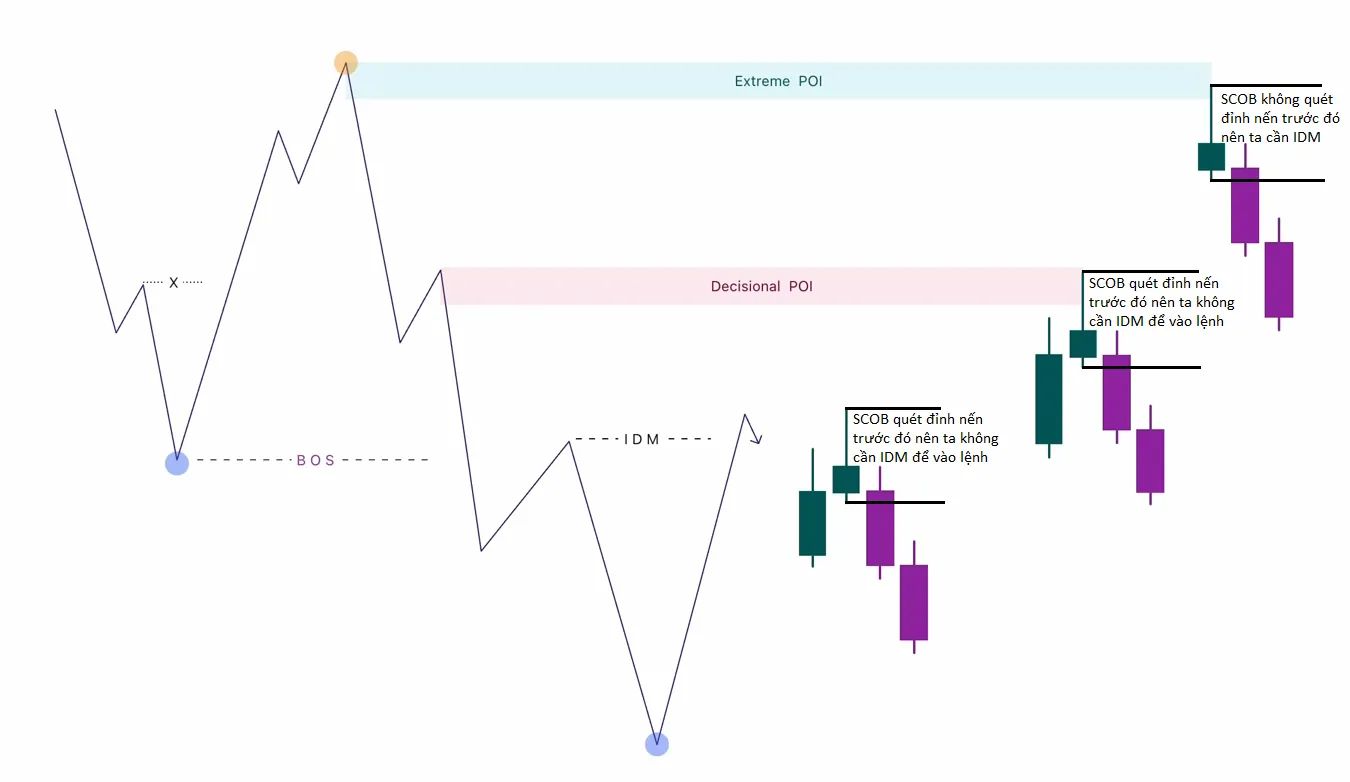 Identifying a Single Candle Order Block
How to identify a POI with SCOB
We can call a Single Candle OB a Single Candle POI. The way to identify it is as follows:
- If the SCOB also sweeps the liquidity of the previous candle, we can also consider that candle wick to be a POI and can enter a trade when price returns to touch it without waiting for IDM at the LTF.
- If the SCOB does not sweep through the high of the previous candle, we consider the whole candle to be a POI and can enter a trade when price returns to touch the POI when it breaks through IDM at the LTF.
Note: Whether you choose the candle wick or the whole candle as the SCOB, this is only probabilistic. Price may still not return to touch the candle wick.
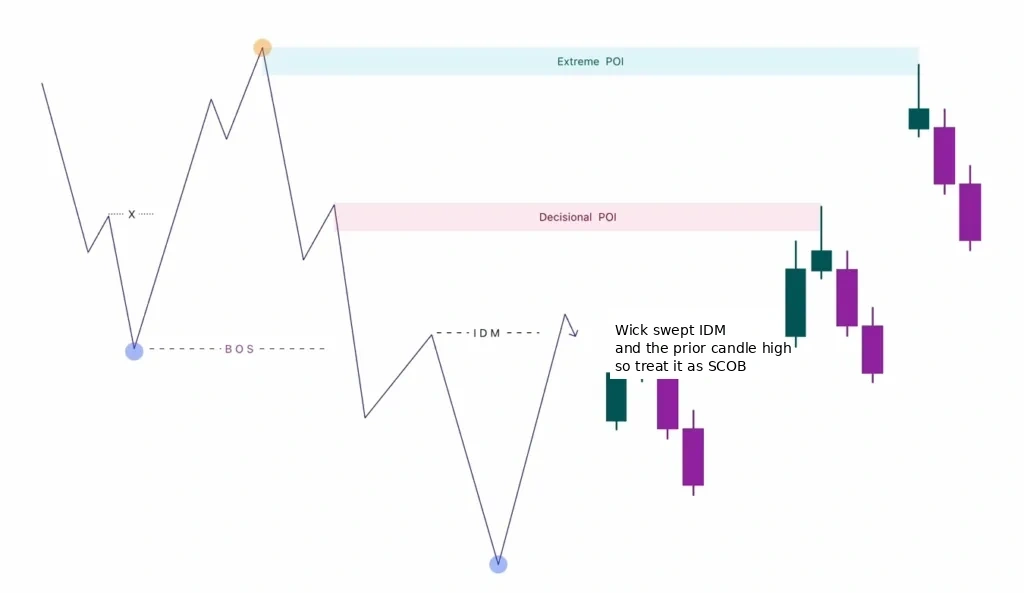 The candle wick can also act as a SCOB
How to enter a trade with a Single Candle Order Block
SCOB forms at extremes or pullback points. The process for entering a trade with SCOB is as follows:
- When a SCOB appears at an HTF POI, we consider whether that SCOB sweeps the liquidity of the previous candle.
- If at step 1, the SCOB sweeps the liquidity of the previous candle, we mark the candle wick as the POI and switch to the LTF to mark the OB to enter a trade right when price touches the wick of this OB without waiting for IDM. If we consider the whole candle at the HTF to be the POI, then when we switch to the LTF and mark the OB, we must wait for price to pass IDM to enter a trade.
- When price moves in line with the main trend, we can add to trades when many SCOBs appear.
In the case where the SCOB is a candle that is too long, we can shorten it to 50% of the candle to calculate the entry.
SCOB - Theory
Remember that every entry is always probabilistic. You will have to choose entries that have a high probability or entries that are safe. There will be no perfect entry here. Sometimes you will miss a trade or hit SL. Balance losing and winning trades to master the SMC method.
Note: For safety, when entering a trade at the LTF we can place SL corresponding to the HTF. If we place SL right in the LTF, it will increase the risk of hitting SL. When price touches a high / low, we should move SL to the breakeven point. Trading Hub 3.0 encourages you to TP half when price touches an LTF high / low and move SL to the breakeven point, and TP the remaining half at the Major high / low at the HTF.
Looking at the scenario below, when the market is in a bearish trend at the HTF and price breaks through Inducement, we will look for an entry when price goes up and touches the POI areas above.
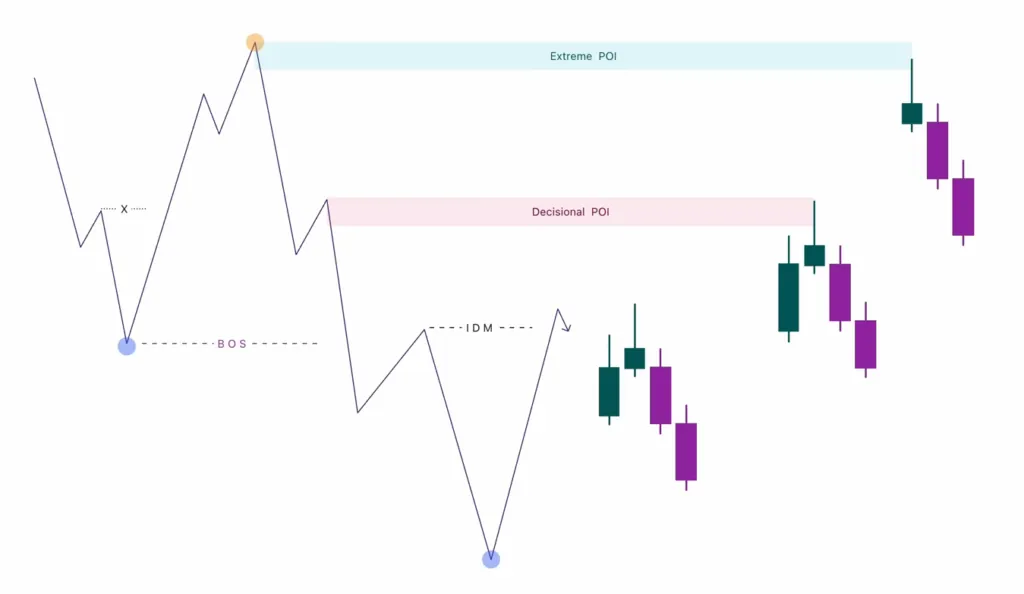 Entering a trade with SCOB
The POI areas in the middle are called Decisional POI with a 50% probability. The Extreme POI area at the very top has higher reliability than the Decisional POI areas.
We will enter trades according to SCOB in turn at three places: IDM (if swept), Decisional POI and Extreme POI, with a gradually increasing win probability, however the likelihood of getting an entry will gradually decrease.
After price touches the HTF POI and then reverses downwards in line with the main trend, we can use SCOB to add to trades for scalping (this will be mentioned in the Single Candle Mitigation section).
SCOB at the LTF
According to the setup above, we usually identify SCOB at the HTF and then switch to the LTF to enter a trade. However, we can still identify SCOB at the LTF without needing the HTF beforehand, and it still gives an entry setup with a high probability.
Specifically, at the LTF timeframe, if price passes IDM and touches a POI, it will be quite risky if we enter a trade right away because that POI is a Decisional POI. Even an Extreme POI can have its liquidity swept. So how do we protect our capital when entering trades at such positions?
The answer is that we will not enter a trade right when price touches the POI, but will wait for a SCOB to appear according to the exact formula: after candle A touches the POI (it can close outside or inside the POI), the next candle closes above it (if you are looking for a Buy trade) or closes below it (if you are looking for a Sell trade), then we mark candle A as a SCOB. When price returns to tap this candle A, we can enter a trade directly.
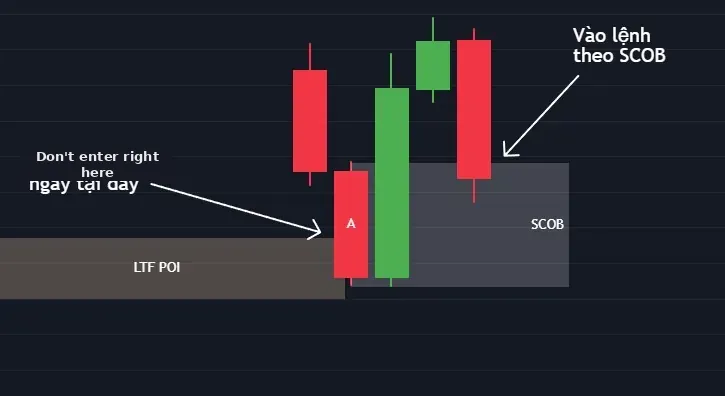 Enter a Buy trade with LTF SCOB
 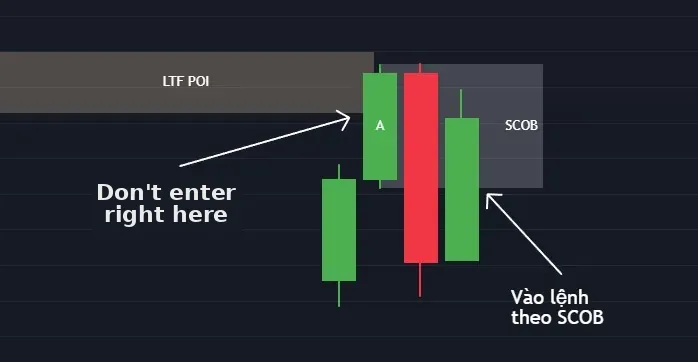 Enter a Sell trade with LTF SCOB Identifying and entering trades with LTF SCOB
If the candle does not form a SCOB at the extreme area, we move to the next OB candles with IMB to mark that OB as the SCOB.
In the example below, price touches the POIs and reacts but does not create a SCOB, so we do not enter a trade. Sometimes we will miss a trade if we do not enter directly, but sometimes we will hit SL.
Using SCOB will help us protect our capital from hitting such SLs.
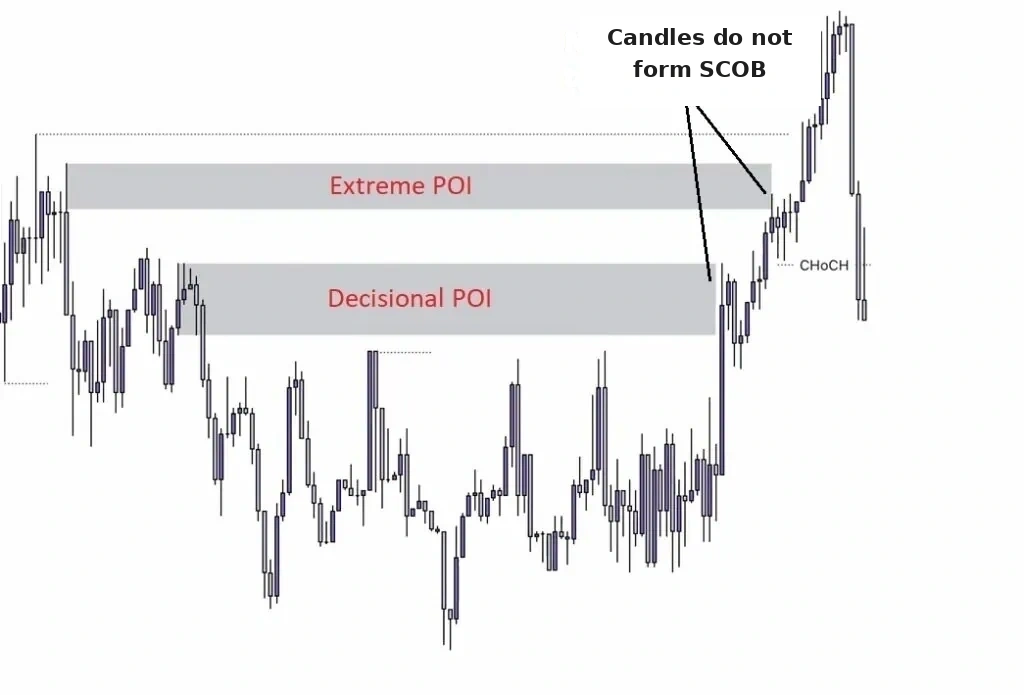 The candle touches the POI but does not create a SCOB
Let us consider the following example of identifying and using SCOB to enter trades at the LTF.
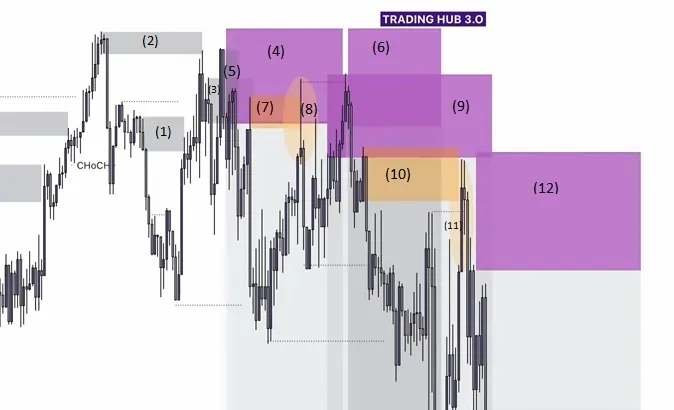 Entering a trade with SCOB at the LTF
In the example above, after creating a CHoCH, price breaks through IDM and touches the Decisional POI (1), however it does not form a SCOB, so we do not enter a trade here. Price goes up and touches the Extreme OB (2) but also does not form a SCOB, so we also do not enter a trade.
The candle did not form a SCOB at (2) but formed a SCOB at (3). We enter a trade when price returns to tap this SCOB.
After price touches (3), we enter a trade right away (4). Candle (5) at this point also becomes a SCOB. Price afterwards returned to tap this SCOB, so we enter a trade right away (6).
Candle (7) has an untapped wick, so it becomes a POI. Price goes down and breaks the structure creating a BOS. We wait for price to pass IDM and go up to touch POI (7). At this point we do not enter a trade right away, but wait for price to create a SCOB.
Candle (8) sweeps candle (7) and becomes a SCOB. We wait for price to return to tap this SCOB (8) to enter a trade (9).
After entering a trade at (9), price creates a pullback (10) and then goes down. This is exactly the OB. We will wait for price to return to tap this OB. Price afterwards goes down and breaks the structure creating a BOS, so we wait for price to pull back, pass IDM and touch POI (9). Similar to above, we do not enter a trade directly, but wait for a SCOB to form (11). Price afterwards returns to tap this SCOB, so we enter a trade (12).
SCOB - Entering trades
5/5 - (1 vote)
Read structure 10x faster with JUKA
JUKA maps SMC structure — swings, BOS, CHoCH and inducement zones — automatically on any TradingView chart. No more hand-drawing structure for hours.
Get JUKA — $150