Trading Hub 4.0 (Part 1): Identifying Bullish / Bearish Candles
Trading Hub 4.0 mainly helps people trade in line with the trend. In this first part, we will discuss everything about the formation of Japanese candlesticks in trading. How to look at candles, which candles you should choose and which candles you should avoid?
Choosing bullish candles
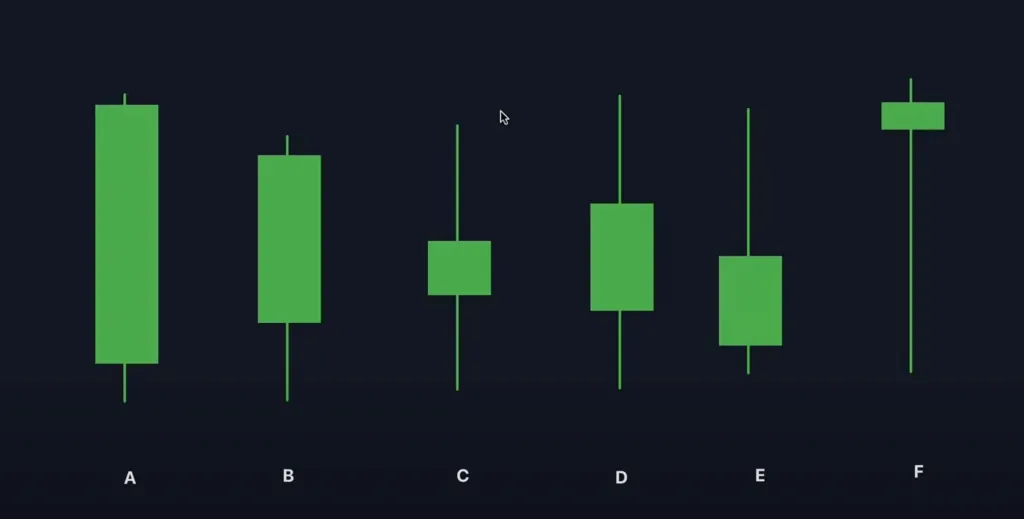 All of the candles look bullish and have wicks
Candles A and B have wide bodies with short wicks, and the upper wick is shorter than the lower wick, so these are 2 candles with very strong momentum.
Candles C and D both have long upper and lower wicks together with a small body, showing the indecisiveness of the candle. The colour of the candle does not decide whether that candle is bullish or bearish.
Candle E has an upper wick longer than its body, showing that buying potential is lower than selling potential.
The last candle is a hammer candle, usually used as a reversal candle, but in most cases the market will trap us.
Never try to trade according to any reversal pattern. The focus of Trading Hub 4.0 is continuation patterns, and if you follow continuation patterns, your probability of winning will be higher.
Of the candles above, you should only focus on candles A and B, which have a long body and short wicks.
Choosing bearish candles
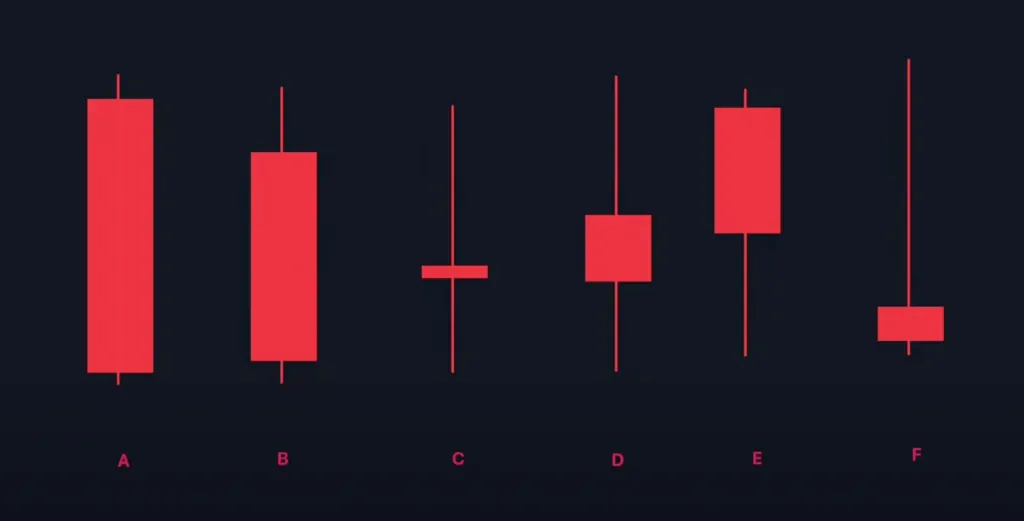 All of the candles are bearish and have wicks
Similar to bullish candles, candles A and B both have a long body and short wicks, and the upper wick is longer than the lower wick. This shows that the selling momentum of these two candles is very strong.
Candles C and D have equal upper and lower wicks, and a very narrow body, showing the hesitation of buyers and sellers.
Candle E looks similar to candle B in that it has a relatively large body, however the lower wick is longer than the upper wick and about as long as the body, showing that buyers are regaining the advantage after sellers have sold down. Therefore this candle is more like a reversal candle than a continuation candle.
Candle F is an inverted hammer candle used in reversal situations.
So, you should only focus on candles A and B because these are two strong continuation candles; the remaining candles are neutral or reversal candles, which will give false moves to trap traders.
Hopefully by now you understand how to choose candles. This knowledge is only basic, but it will help you know which candle to choose and which candle not to choose.
Pay attention to candles with a long body and minimal wicks. If the market creates these types of candles we can take part in trading, see the following parts.
5/5 - (1 vote)
Read structure 10x faster with JUKA
JUKA maps SMC structure — swings, BOS, CHoCH and inducement zones — automatically on any TradingView chart. No more hand-drawing structure for hours.
Get JUKA — $150