ICT Part 12: What Is CISD? What Is MSS? Comparing CISD and MSS
In ICT there are potential models that help you detect a reversal or retracement of price, including CISD, Turtle Soup, AMD and MSS. In this article we will learn about CISD and MSS.
What Is CISD in ICT?
ICT CISD is short for Change in the State of Delivery, for example if price originally moved in a bullish direction, then now, after an ICT CISD, price will move in a bearish direction.
Identifying CISD:
- In bullish market conditions, CISD is the opening price of the first candle that creates the upward move but fails when it touches an important PDA level on the HTF and reverses to close below that opening price.
- In bearish market conditions, CISD is the opening price of the first candle that creates the downward move but fails when it touches an important PDA level on the HTF and reverses to close above that opening price.
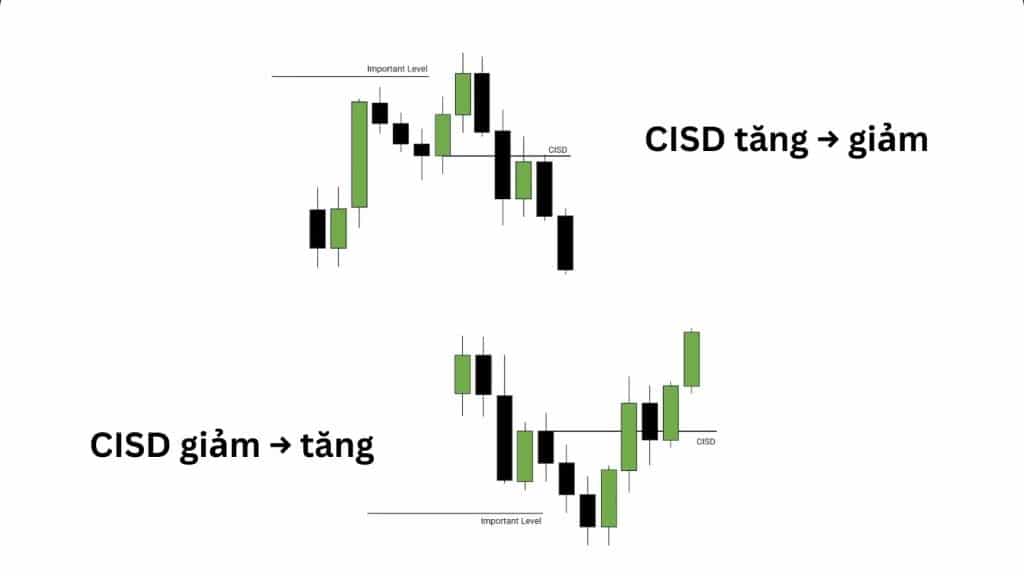 What is CISD?
Entering Trades with CISD
Entering a trade with CISD is very simple:
- Wait after price touches a PDA on the HTF and reverses to move in the opposite direction.
- Price closes with a candle through the CISD.
- Enter at the CISD when price pulls back to it.
Note that CISD appears before MSS, so it carries higher risk; however, in many cases if we wait for a complete MSS we will miss the trade.
To increase the win rate, we should combine it with the overall market context and observe the move created by the CISD and how that move fails when it touches an HTF PDA.
A CISD that creates a clear FVG will give a higher win rate.
What Is MSS? Comparing MSS with CISD
In ICT, MSS (Market Structure Shift) is the initial signal of a trend reversal, which can be a short-term or long-term change in market structure.
MSS is also called CHoCH, expressed by price breaking and closing with a candle through a swing low or swing high, accompanied by a displacement.
Illustration of MSS in an uptrend:
 What is MSS in ICT?
There are two forms of MSS in ICT:
- Price creates an HH and touches an HTF PDA, then reverses, creating displacement that closes with a candle through the nearest low.
- After touching an HTF PDA, price creates an LH, then reverses, creating displacement that closes through the nearest low.
Important: We use form 2 of MSS in cases where the swing low lies too far away.
CISD and MSS are similar in that both are trend reversals; however, CISD appears earlier because it is an opening price level, helping traders not miss trades.
Whether it is CISD or MSS, we both need to observe how displacement appears when it breaks through it.
CISD Example
 CISD example on EU in ICT
In the example with the EUR/USD currency pair, on the H4 timeframe we see price pulling back to Order Flow.
Observing the preceding context, we notice price took EQH with a large candle but failed when it touched the OF and reversed.
This large candle was created by CISD; after the reversal, price closed with a candle below the CISD, creating MSS, and our entries are exactly the two CISD and MSS positions.
Drop to m15 to confirm the entry:
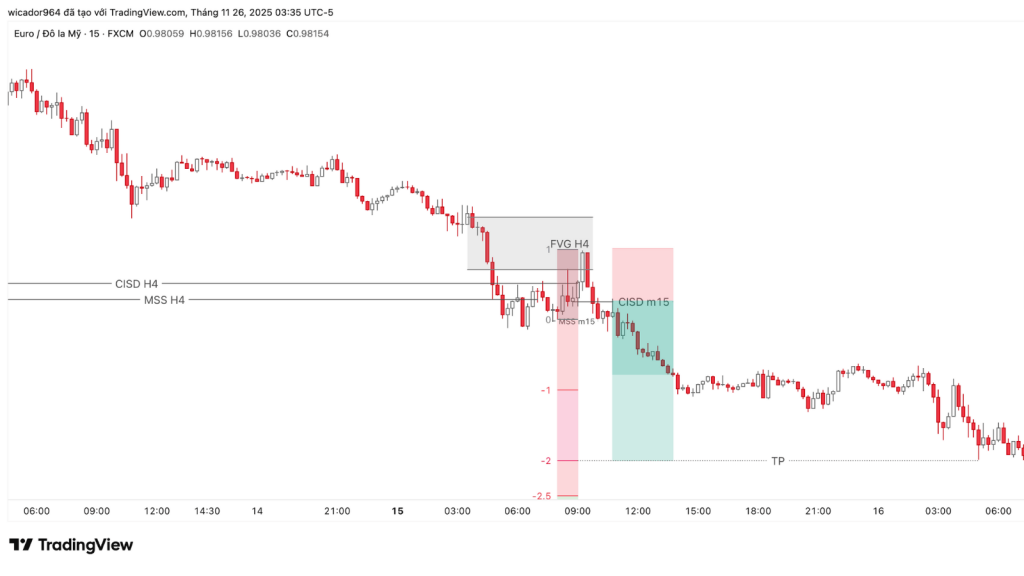 CE on m15
- After MSS on H4, drop to m15 and observe an m15 CISD appearing, creating a move that pushes price to touch the H4 FVG (which is also an m15 FVG at the same time).
- Then price reverses and closes with a candle below the m15 CISD. Our position is opened when price pulls back to the m15 CISD.
- Take profit using Fibonacci at level 2.
FAQ
Should You Wait for MSS to Enter a Trade?
- If MSS lies too far away or appears much later than CISD, you can enter right at CISD, especially when there is an FVG supporting it.
- If MSS lies close to CISD, you should combine both.
When Should You Prioritise MSS over CISD?
- When the market is noisy.
- When CISD does not create a clear FVG or the candle body is too small.
- MSS is suitable for filtering noise and increasing confirmation, while CISD is suitable for not missing trades.
Is It Necessary to Wait for a Candle Close Through CISD?
CISD needs a candle close to confirm; when price closes with a candle through CISD we do not need price to close with a candle through MSS.
Is CISD a Reversal Signal?
Yes. CISD usually appears very early in the reversal process (earlier than MSS), so it helps traders catch a more sensitive entry but also carries a higher level of risk.
Is CISD Reliable?
CISD gives an early entry but has lower reliability than MSS.
However, if CISD creates a clear FVG, or fails right at an HTF PDA, the probability of winning will be considerably higher.
Read structure 10x faster with JUKA
JUKA maps SMC structure — swings, BOS, CHoCH and inducement zones — automatically on any TradingView chart. No more hand-drawing structure for hours.
Get JUKA — $150