Liquidity Sweep Reversals: A 15-Minute Trading Strategy
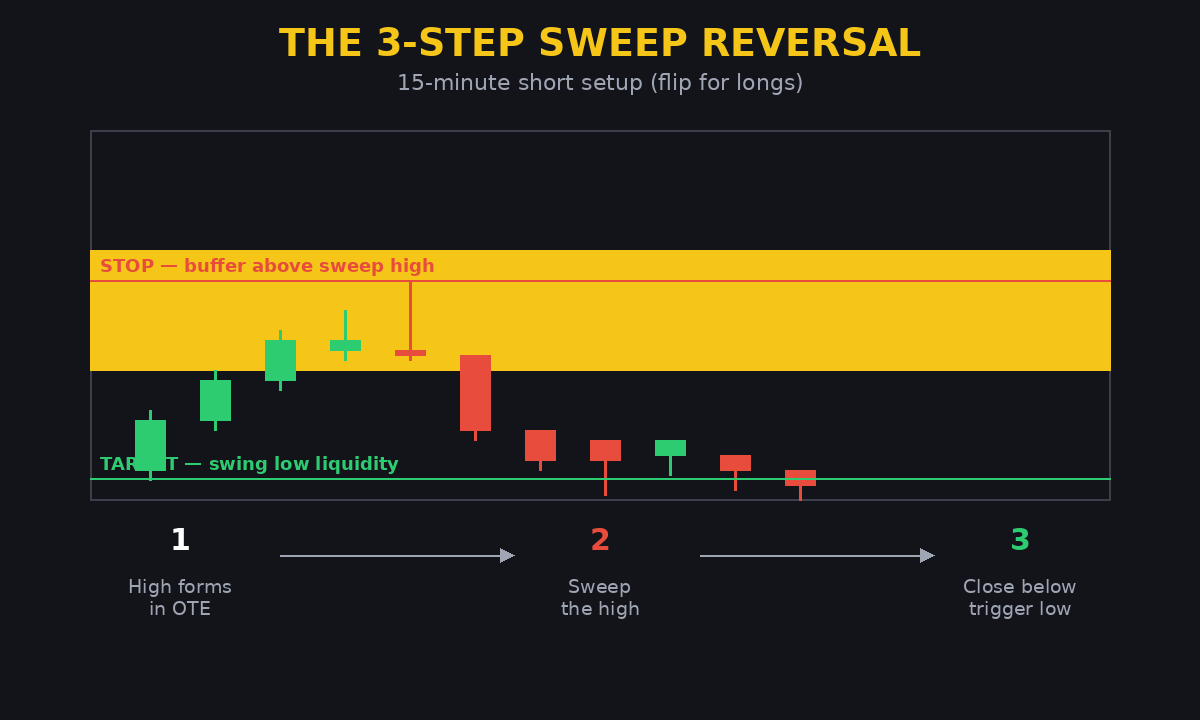
Most traders see a liquidity sweep and freeze — was that a breakout or a trap? This strategy answers that question with a mechanical three-step pattern traded on the 15-minute chart: context first, location second, sweep third. No guessing, no chasing. If any step is missing, there is no trade.
Why sweeps reverse (the logic)
A liquidity sweep is price spiking beyond a key high or low to trigger resting stops, then failing to hold there. The stops that get triggered are buy orders (above a high) or sell orders (below a low) — and somebody has to take the other side of every order. When large participants absorb that liquidity, they have what they need to push price the other way.
The reversal edge comes from positioning: retail sees the sweep as a breakout and piles in; smart money sees it as fuel collected and starts the real move. Your job is to be on the smart money side — which means never entering on the sweep itself. The sweep is the setup forming, not the entry.
Step 0: Higher-timeframe context (non-negotiable)
Before anything else, read the 1H or 4H structure. You need a clear trend — lower highs and lower lows for shorts, higher highs and higher lows for longs. The sweep reversal is a with-trend strategy: you're catching the continuation after a pullback, not picking bottoms against the trend.
Trading this pattern without HTF context is just gambling on wicks. The higher timeframe gives direction; the 15-minute gives the entry. Our top-down guide covers this discipline in full.
Step 1: Price reaches the OTE zone
From the most recent external high to the external low (in a downtrend), draw a Fibonacci retracement. You're interested in the OTE zone — the 62–79% retracement. This is where pullbacks in a trend most often terminate, and where institutions reload.
If price never reaches OTE, there is no setup. Don't lower your standards and take sweeps in the middle of nowhere — the location filter is what separates this strategy from random wick-trading.
Step 2: The three-step sweep pattern
Once price is in OTE on the HTF, drop to the 15-minute chart and wait for this exact sequence (described for a short; flip it for a long):
2a. A swing high forms inside OTE. Price retraces into the zone and prints a local high. Stops and breakout orders are now building above it — that's the liquidity pool the market needs.
2b. Price sweeps the high. A wick (or a few candles) pushes above that high, triggering the stops. Breakout traders get trapped long. This is the sweep — watch it happen, don't trade it.
2c. Acceptance back below the trigger low. Wait for a 15-minute candle to close below the low of the candle that pushed into the sweep. That close is your confirmation: the market probed for buyers above, found sellers instead, and accepted lower prices. No close, no trade.
All three steps are mandatory. A sweep without OTE location is noise. OTE without a sweep is just a zone. The close is what turns observation into a signal.
Entry rules
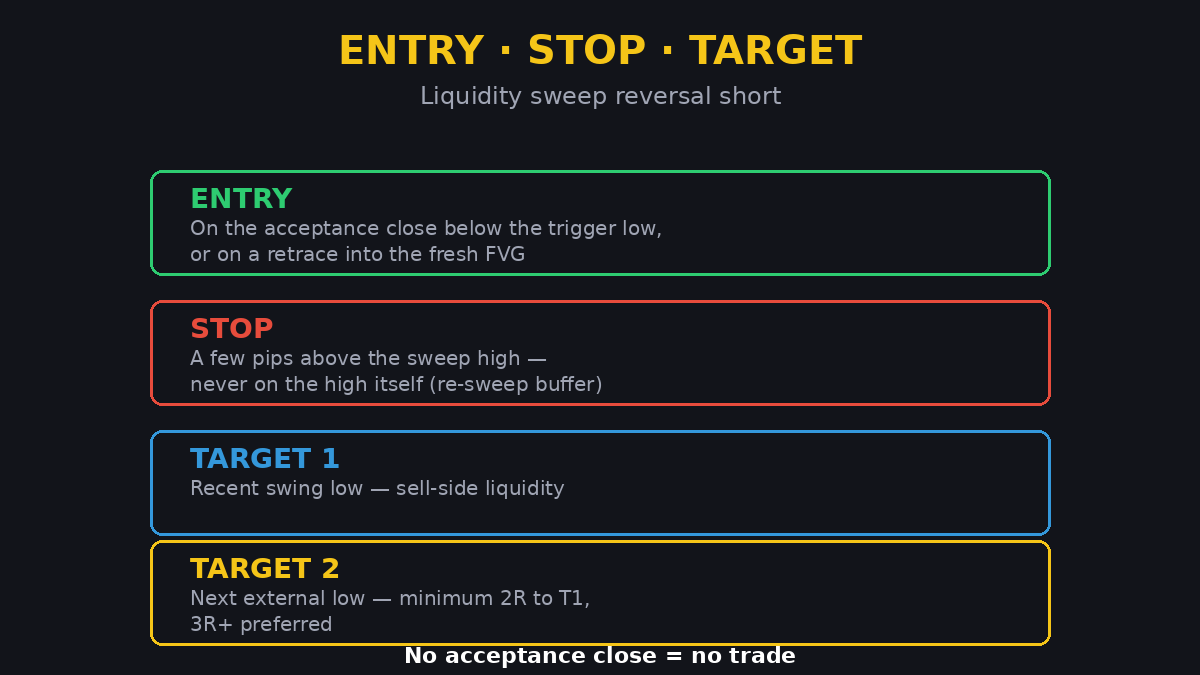
Enter short on the confirming close, or wait for a small retrace into any fresh imbalance (FVG) the confirmation move left behind. Both work — the close entry gets you in earlier with a slightly wider stop; the retrace entry gives a better price but risks missing the move if price doesn't look back.
Either way, the confirmation close is the trigger. Entering before it means you're anticipating the sweep will fail — and sometimes sweeps keep going and become genuine breakouts.
Stop loss placement
The logical stop sits a few pips above the sweep high — not on it. That buffer matters: markets often re-sweep a level before reversing, and a stop placed exactly on the high gets taken by the second probe.
A tighter alternative is the most recent minor lower high inside the structure, but accept the tradeoff: tighter stop, higher chance of getting wicked out before the move develops. Never place the stop at a random distance — it must sit where your idea is proven wrong.
Profit targets
Because you're trading with the HTF trend, targets are natural: the recent swing low first (where sell-side liquidity rests), then the next external low beyond it. Pre-mark both before entering.
Demand a minimum of 2R to the first target; 3R or better is the standard worth waiting for. If the sweep high is so far from current price that even the second target can't deliver 2R, skip the trade — the location was right but the entry came too late.
Sweep vs CHoCH: why earlier matters
A full change of character on the HTF often confirms the same reversal — but much later, after a big chunk of the move is gone. The sweep pattern frequently fires before the CHoCH, because the sweep is the mechanism that causes the structure shift.
Earlier confirmation means a tighter stop and a better R-multiple on the same move. That's the entire edge of this strategy: same direction as the eventual CHoCH, better price.
Four ways traders ruin this setup
1. Trading sweeps without HTF context. A sweep in a range, against no trend, is a coin flip. Context is the strategy.
2. Entering on the sweep candle. The wick above the high is not your entry — it's the trap springing. Wait for the acceptance close.
3. Using wick breaks instead of closes. A wick below the trigger low that closes back above it is not confirmation. Closes only.
4. Forcing it outside OTE. Every sweep on the chart is not your sweep. If price isn't in the 62–79% zone of the HTF pullback, let it go.
The takeaway
Liquidity sweep reversals work because they align three forces: HTF trend direction, institutional location (OTE), and the mechanical footprint of stops being harvested. Miss any one and the probabilities collapse. Keep all three, wait for the acceptance close, protect the idea with a logical stop — and let the pre-marked liquidity targets do the rest.
Stop Drawing Structure by Hand
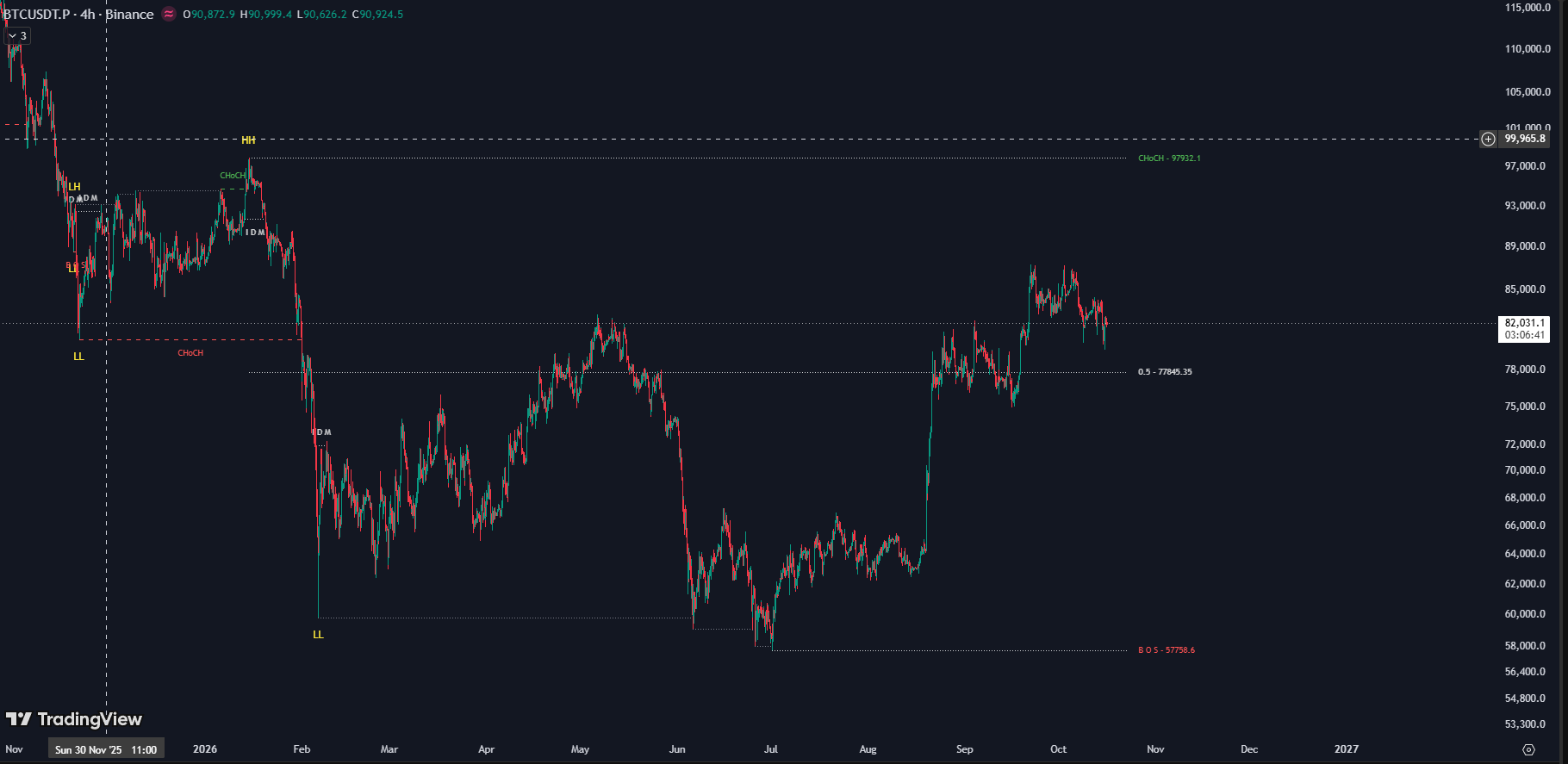
This is JUKA live on BTC 4H — every swing, BOS, CHoCH, IDM, and the premium/discount equilibrium labeled automatically, in real time.
No missed breaks. No mislabeled noise. No hours of hand-drawing. Full Pine Script v5 source code — yours to own forever, $150 one-time.
Get JUKA Source Code — $150