Learn Smart Money Concepts
If you want to learn Smart Money Concepts, the fastest way is also the simplest: study the concepts in the right order, on real charts, one idea at a time. Most beginners fail not because SMC is hard, but because they learn 40 concepts at once with no fixed sequence — so nothing connects. This path fixes that. Work through these 8 lessons in order and you will go from "what is SMC" to reading a chart the way institutional traders do.
Smart Money Concepts: The Complete SMC Guide
Start with the big picture. What smart money actually is, why institutions leave footprints on every chart, and how every SMC concept connects into one method — before you zoom into any single piece.
What Is Market Structure in Trading? The Complete SMC Guide
The foundation everything else hangs on: swing highs and lows, BOS, CHoCH, internal versus external structure, and the top-down workflow. If you learn only one lesson properly, make it this one.
Liquidity Sweeps: How Smart Money Hunts Stops
Why wicks pierce swing highs and lows before reversing, how to tell a sweep from a genuine break, and how to read stop hunts as context instead of getting caught in them.
What Is an Order Block? SMC OB Trading Guide
The zones where institutional orders sit: what an order block is, how to spot a valid one, and how to enter when price returns to it.
What Is Imbalance (FVG) in SMC Trading?
The gaps price leaves behind when institutions move fast: what an imbalance (fair value gap) is, why price often returns to fill it, and how it confirms an entry zone.
Premium vs Discount Zones Explained
How the equilibrium (0.5) of a dealing range divides where smart money buys from where it sells — and why retail keeps buying tops and selling bottoms.
CHoCH Entry Strategy: How to Trade CHoCH
From reading to acting: how a change of character becomes a complete entry module — bias, zone, trigger, stop, and target — with the rules that keep it mechanical.
SMC Top-Down Analysis: HTF Bias, LTF Entries
Put it all together across timeframes: the higher timeframe sets direction, the lower timeframe only refines entries — so a 15-minute signal never overrides a daily bias again.
Frequently asked questions
How long does it take to learn Smart Money Concepts?
Most beginners can read structure, liquidity, order blocks, and imbalance within a few weeks of focused study. Turning that knowledge into consistent decisions takes longer — usually several months of chart time — because SMC is a reading skill, not a checklist to memorize.
What should I learn first in Smart Money Concepts?
Market structure first. If you cannot read the sequence of swing highs and lows, every other concept floats in a vacuum. After structure, learn liquidity, then order blocks, then imbalance — in that order, which is exactly the order of this path.
Do I need indicators to learn Smart Money Concepts?
No. SMC is read from price itself: structure, swept highs and lows, order blocks, and gaps. Indicators are optional confirmation, never the method. Learning SMC on a clean chart first is what makes the concepts stick.
Can I learn Smart Money Concepts for free?
Yes. This learning path and every lesson it links to is free, and the free Trading Hub 3.0 ebook covers the same foundations in one PDF you can keep.
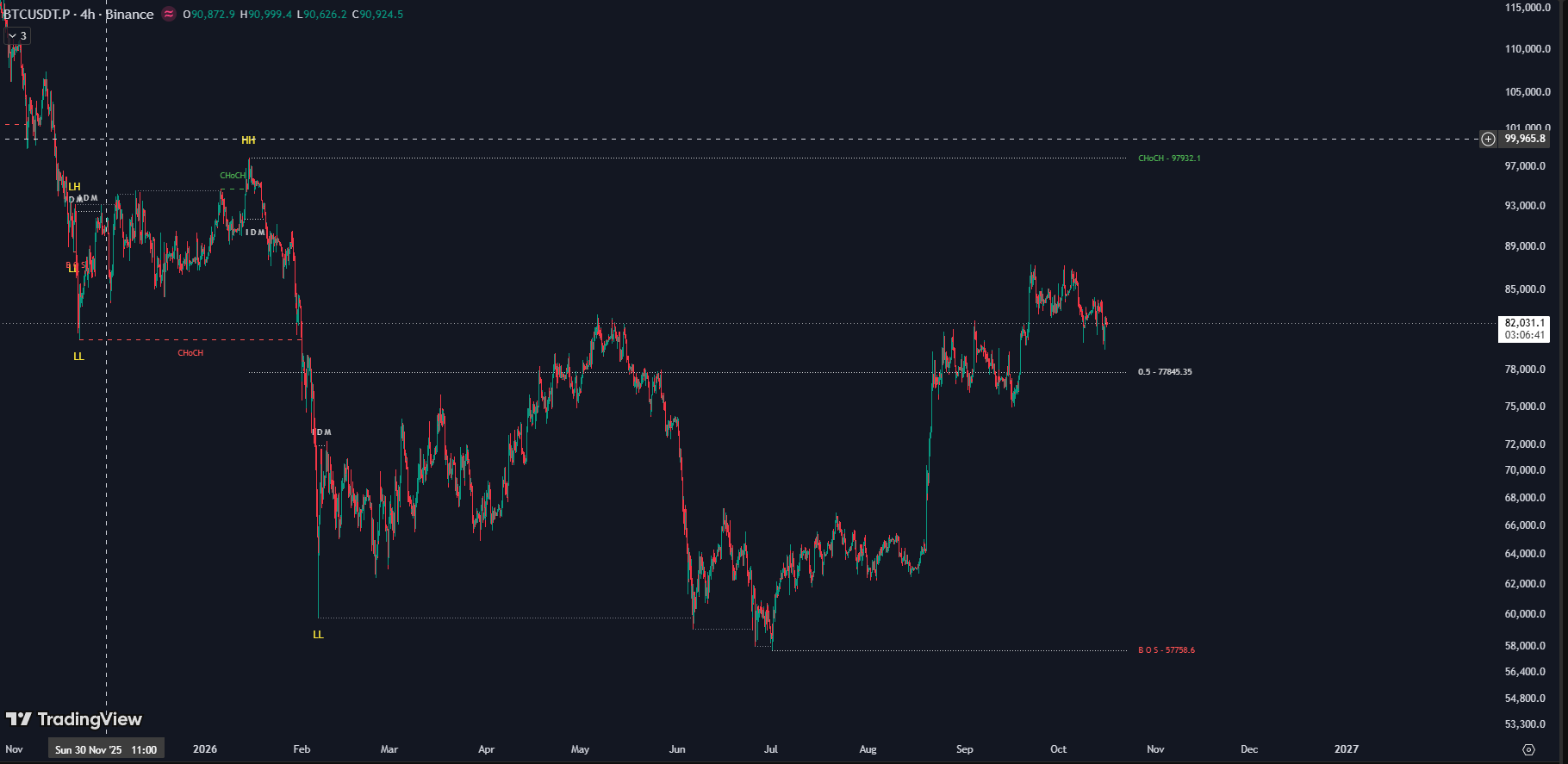
Stop Drawing Structure by Hand
This is JUKA live on BTC 4H — every swing, BOS, CHoCH, IDM, and the premium/discount equilibrium labeled automatically, in real time.
No missed breaks. No mislabeled noise. No hours of hand-drawing. The complete Trading Hub 3.0 source code (Pine Script v5) — yours to own forever, $99 one-time. Or $50/year for invite-only access on TradingView.
Try free for 3 days — contact us on Telegram