Trading Hub 3.0 (Part 14): How to Trade Two-Way Ping Pong with Internal Structure – SMC
Trading the internal structure in the Smart Money Concepts method will help us enter trades without needing to pay attention to the trend of the main structure.
Thanks to internal structure, we can enter trades in both directions, buy and sell, either counter to or in line with the trend of the main structure on the HTF.
In the Trading Hub 3.0 material, this is called a Ping-pong entry.
What is Ping Pong?
When you start trading both ends, the main move and the secondary move, it is called a Ping Pong entry.
These are the hardest types of entries because very few people can Buy and Sell on both sides, but Trading Hub 3.0 will help you understand it more easily. This part will help you a great deal in understanding whether you should take part in a trade or not.
If you do not like trading both ends, you can skip this, because it is not only Ping Pong traders who make money. Focus on your strengths — for example, I only like to SHORT the market. I mostly Sell and rarely Buy.
First, let us remember the rule: After price breaks structure creating a BOS / CHoCH, at the LTF the first pullback that gets broken is not where we enter, because this is where retail traders concentrate, so SMT often appears there. We should wait for price to form a new structure at the LTF to enter a trade.
Ping Pong entries in a bearish market
Always remember these 2 things when looking for a Ping Pong Entry if the structure is bearish:
- If price taps into Demand or sweeps the previous low, enter a Buy, and this Buy is only short-term.
- If price taps into Supply or sweeps the session high, Sell at the LTF and hold the trade to let it run further.
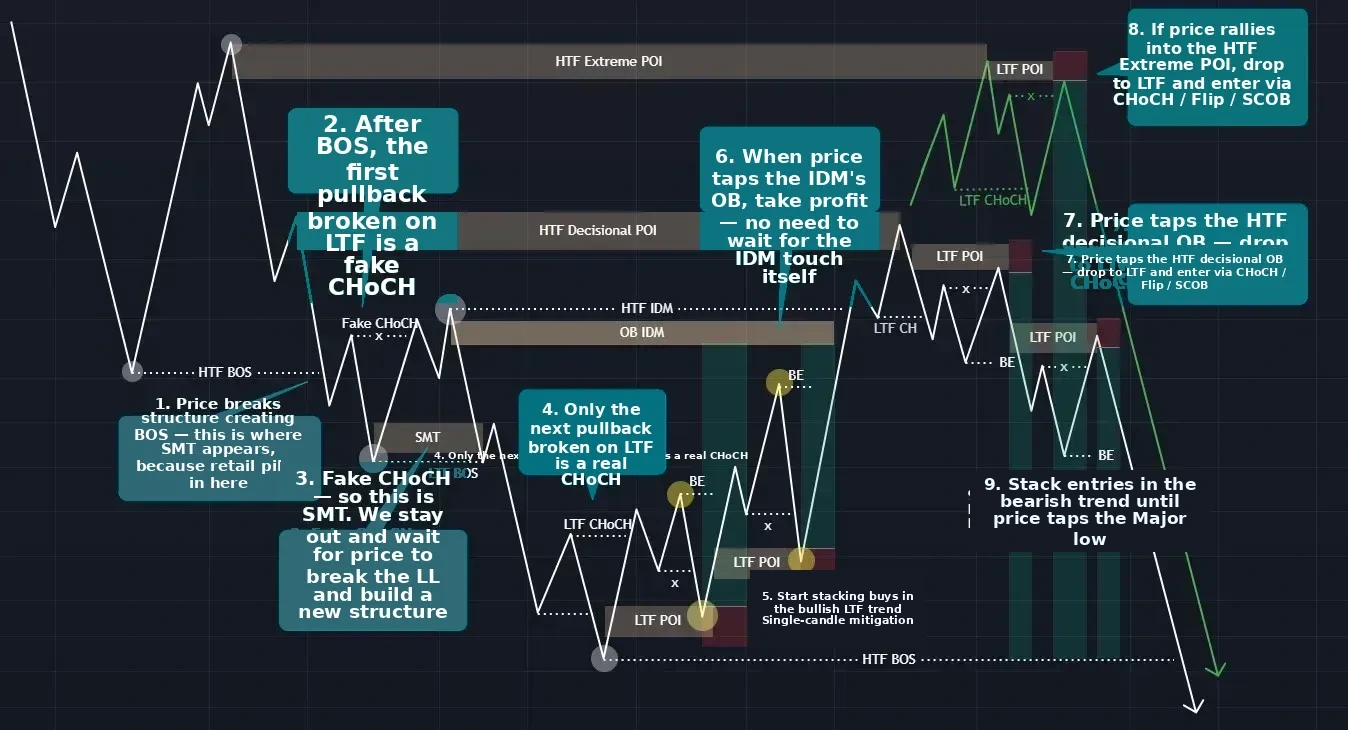 Ping Pong entry in a Bearish market
Let us analyse the chart above:
(1) In a downtrend, when price breaks structure on the HTF creating a BOS, we switch to the LTF to start analysing.
(2) Remember that the first pullback area that gets broken is a fake CHoCH (see the rule above again).
(3) Because the above is a fake CHoCH, that area is SMT, and price is highly likely to break structure one more time.
(4) Wait for price to move down creating an LTF BOS, then when price breaks up through the first pullback, this is highly likely to be a genuine CHoCH (after a fake CHoCH, every CHoCH after that can be a genuine CHoCH).
The types of Buy entries we can look for are as follows:
- Price breaks structure (BOS), breaks through the LTF IDM and then taps into an LTF POI -> enter the trade.
- Price taps into an LTF POI and creates an SCOB -> set up an entry if price comes back to mitigate the SCOB.
- Price creates a Single candle mitigation -> enter the trade with SCM.
(5) Scale in following Single candle mitigation (see Part 13 - SCM) in an uptrend, combined with a Single candle order block to increase the win rate (see Part 10 - SCOB).
(6) Take profit, stop loss, break-even. Because the main trend is Bearish, we will do the following:
- TP: according to the thinking of the SMC method, price will continue the previous trend after it breaks through the IDM and taps into a POI. Therefore, we will set TP at the IDM of the HTF. However, there will be cases where price reverses before tapping into the IDM (see the image below), and at that point the IDM will move to a new location. So to avoid this case, we should take profit at the Order Block of the IDM.
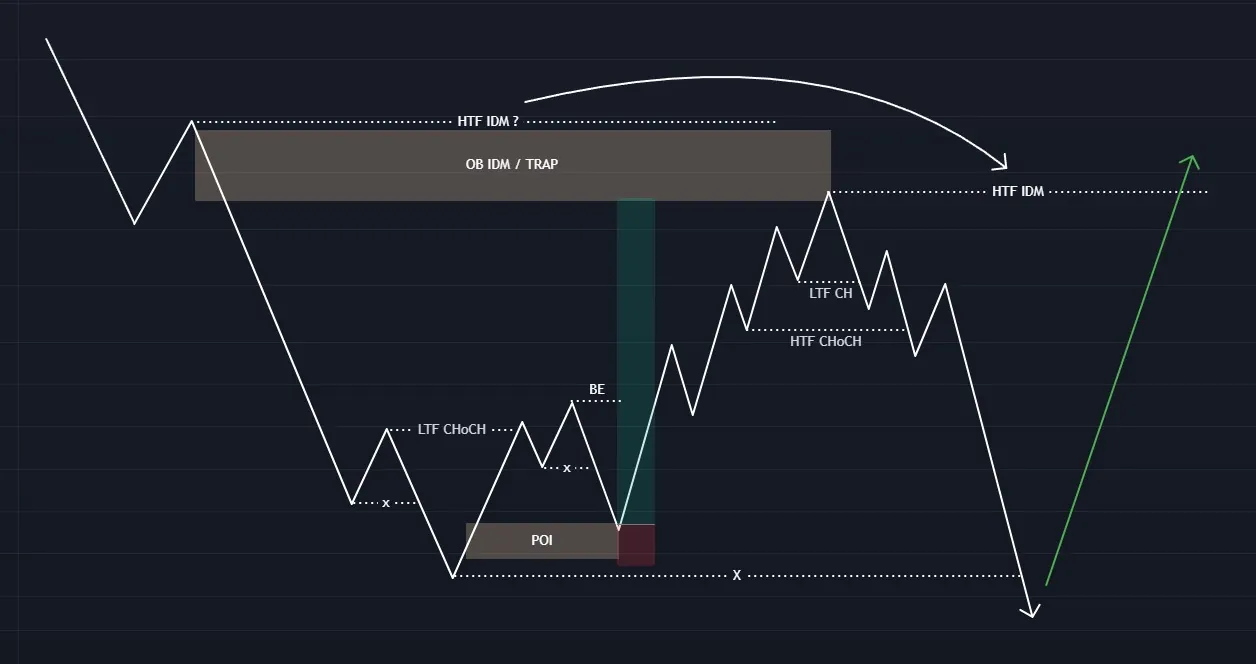 Take profit at the OB of the IDM on the higher timeframe
- SL: as usual, we place the stop loss below the POI. To be safer, place the SL below the low of the previous candle or the low on the HTF.
- BE: this is the break-even point; we should set BE at the HH of the LTF. When price reaches BE, take partial profit and move the SL to break-even. If below there is no valid POI left (all OB/OF have been mitigated), we can confidently move to BE and wait for full TP above without needing to take partial profit first.
In the case where this is still not a CHoCH and the market continues to move down, we already have BE to protect our capital. Wait for the next CHoCH to appear.
(7) When price breaks through the HTF IDM and taps into the Decisional POI on the HTF, this is an area with a 50/50 probability for entries. We switch to the LTF to enter if there is confirmation from CHoCH, Flip, or SCOB to increase the probability of winning.
Refer to how Trading Hub 3.0 takes profit: TP at the LL of the HTF and BE at the LL of the LTF. This way of taking profit is very suitable when the market is in a bearish trend; we boldly let price run further, all the way to the HTF LL and create an HTF BOS.
(8) When price does not stop at the Dec POI but moves up to tap into the Extreme POI, this is the area with the highest entry probability, so we can enter if there is confirmation from CHoCH, Flip, or SCOB at the LTF. As above, we set TP at the LL of the HTF and BE at the LL of the LTF.
Note: POIs located between the Extreme POI and the Decisional POI on the HTF are highly likely to all be SMT; avoid trading at these locations.
(9) Scale in following Single candle mitigation (see Part 13 - SCM again) in a downtrend.
In the case where price sweeps the HTF IDM and leaves a wick rejection to take liquidity, we can look for a Sell trade because this is the first signal of a trend reversal. It is very likely that after sweeping liquidity at the IDM, price will no longer seek the POIs above. Readers can switch to the LTF to look for entry confirmation with CHoCH, Flip, or SCOB.
Ping Pong entries in a Bullish market
Always remember these 2 things when looking for a Ping Pong Entry if the structure is bullish:
- If price taps into Supply or sweeps the previous high, enter a Sell, and this Sell is only short-term.
- If price taps into Demand or sweeps the session low, Buy at the LTF and hold the trade to let it run further.
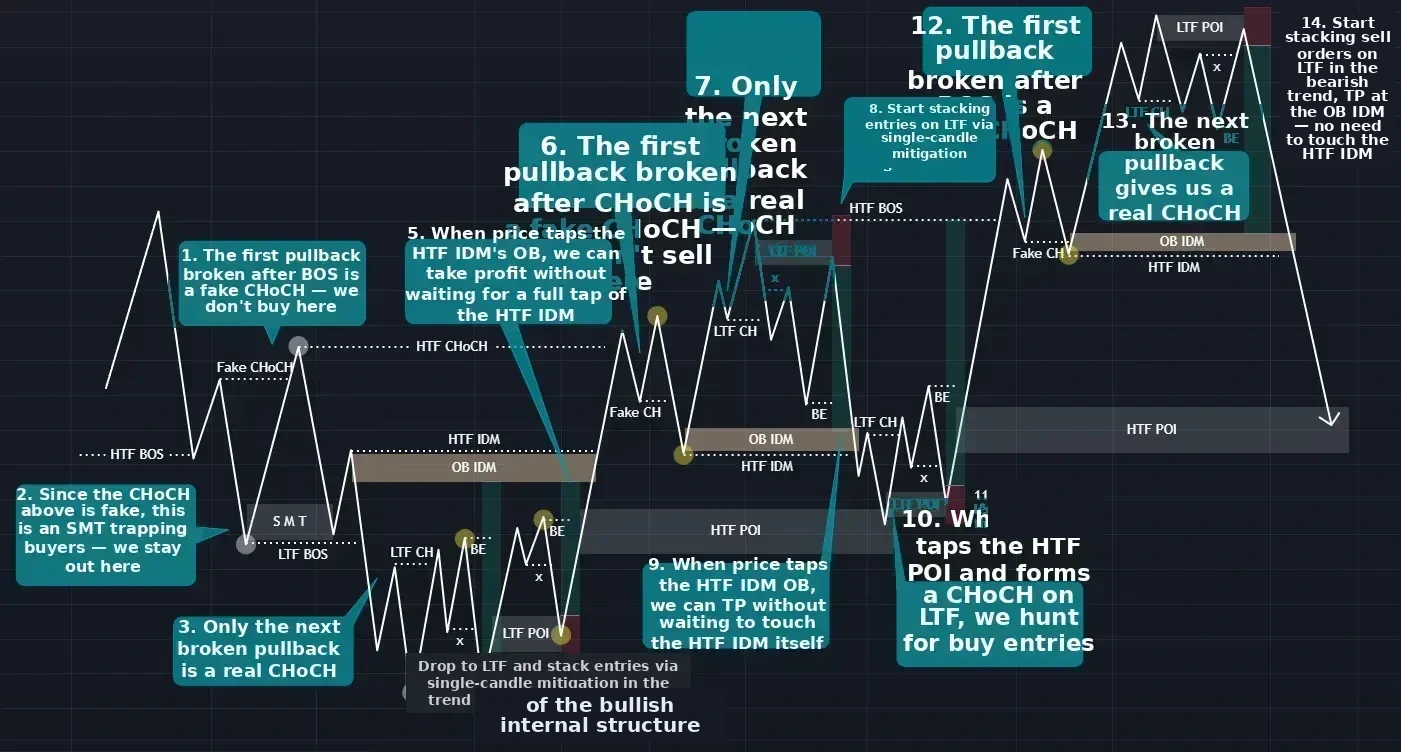 Ping pong entry in internal structure when bullish
Let us analyse the chart above together:
(1) As mentioned above, after a break of structure, the first pullback that gets broken through is a fake CHoCH; we do not look for a Buy entry here because this is where retail traders concentrate the most.
(2) SMT appears to induce Buyers into trades; most retail traders will enter here because they think the market has created a CHoCH.
(3) After the first pullback, pullbacks that are broken through afterwards can all be a real CHoCH. We wait for price to come back, break the IDM and tap into an LTF POI to enter. Or if price sweeps liquidity at the IDM, we can also enter.
(4) We start scaling in at the LTF following Single candle mitigation of the uptrend. See Part 13 - SCM again to understand how to scale in.
(5) Take profit, stop loss, break-even:
- TP: because a CHoCH has only just appeared at the LTF, we are not sure whether the trend has reversed from Bearish to Bullish on the HTF yet, so we need to be careful and should not set TP too far. We will still TP as before at the position of the OB IDM of the HTF.
- SL: as usual, we place the stop loss below the POI. To be safer, place the SL below the low of the previous candle or the low on the HTF.
- BE: we will still set the break-even point at the HH of the lower timeframe. Do not forget to take partial profit and after that move the SL to the break-even point.
(6) At this point price breaks through the HTF CHoCH, showing that the market has truly turned Bullish. After creating a CHoCH, the first pullback that is broken through at the LTF is a fake CHoCH. We will not enter a Sell here.
(7) After the fake CHoCH, the following CHoCHs are all likely to be genuine CHoCHs. Here a CHoCH has appeared, and we will start looking for a Sell trade.
(8) Start scaling into Sell trades whenever we encounter a Single candle mitigation, combined with SCOB to increase the win rate.
(9) Because the main trend is Bullish, we will Sell short-term and set TP at the OB IDM of the HTF, BE at the LL of the LTF.
(10) Price may break through the IDM to tap into an HTF POI creating a CHoCH, or may only sweep the IDM and leave a wick rejection; we can enter a Buy.
(11) Scale into Buy trades in line with the uptrend using SCM combined with SCOB. Because this is in line with the main trend, we boldly set take profit at the major high; of course, we still need BE at the LTF HH.
(12) The market rises until it breaks structure on the HTF and creates an HTF BOS. As above, after creating a CHoCH, the first pullback that is broken through is a fake CHoCH; we will not enter a Sell here.
(13) The next CHoCH is likely to be a real CHoCH; we will look for a Sell trade in this area. If price continues to move up creating a CHoCH above, we already have BE to protect our capital.
(14) After creating a genuine CHoCH, we start scaling into Sell trades following SCM combined with SCOB. Because this is counter to the main trend, we set TP at the OB IDM on the HTF and BE at the LTF LL. Price may move down to tap into an unmitigated OB below, but we do not hold this trade for long because the trade is counter to the trend.
3/5 - (4 votes)
Read structure 10x faster with JUKA
JUKA maps SMC structure — swings, BOS, CHoCH and inducement zones — automatically on any TradingView chart. No more hand-drawing structure for hours.
Get JUKA — $150