You've Watched 50 SMC Videos and Still Can't Enter a Trade. Here's Why.
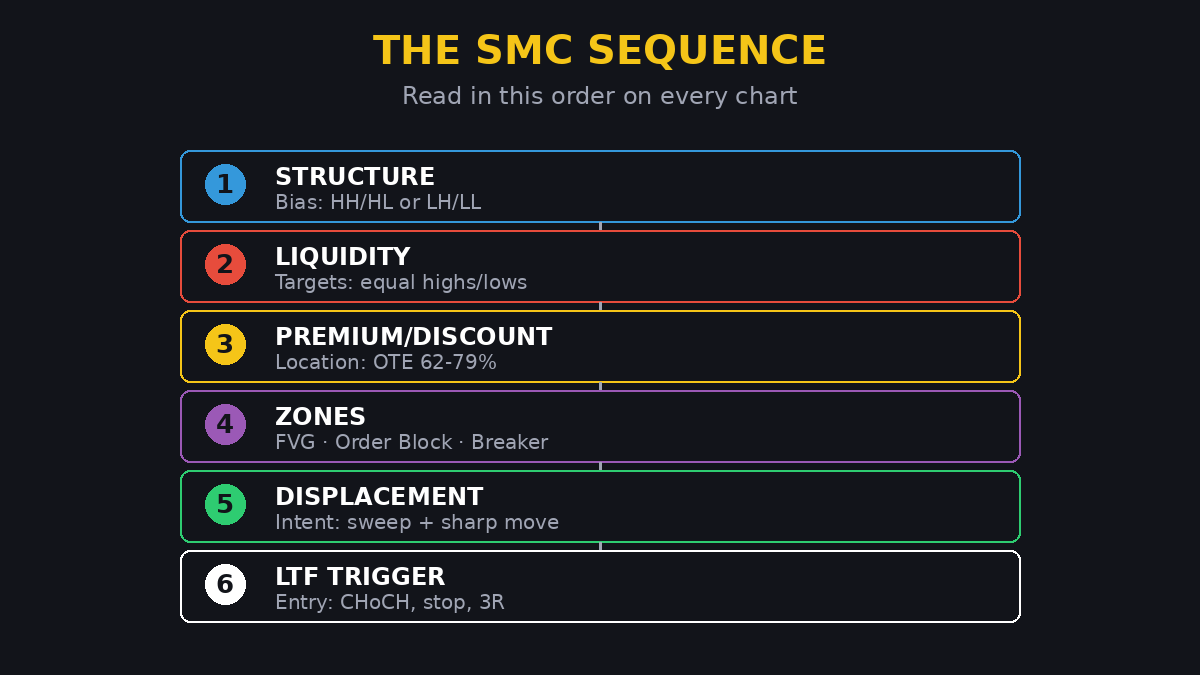
You don't lack concepts. You lack a sequence. This is the order — run it the same way on every chart.
You can define BOS, CHoCH, FVG, order blocks and inducement in your sleep. And yet, at the live right edge of the chart, you freeze: should I enter here? Now? On what? If that is you, stop buying courses. Your problem is not knowledge — it is that you collected forty concepts and nobody ever gave you a fixed order to use them in. Knowledge without a sequence is just expensive noise.
Your brain is full. Your process is empty.
Think about what most SMC education actually does: video one teaches BOS, video two teaches order blocks, video three teaches FVGs. Each video is a new toy, and every live chart becomes a pile of toys with no instructions. You mark three FVGs, spot an order block, wonder whether the CHoCH counts — and take nothing, because no single rule told you which one matters first.
Professional traders do not think in concepts. They think in checklists. The concepts are vocabulary; the checklist is the sentences. Below is the entire sentence — four steps, same order, every single time. No step four without step three. No entry without all four.
Step 1: Read the higher-timeframe structure (your bias)
Open the HTF — for day trading, the 1-hour is a solid choice — and answer exactly one question: who is in control? Higher highs and higher lows: buyers. Lower highs and lower lows: sellers. This is your bias, and it is a one-way filter: you only hunt longs in an uptrend, only shorts in a downtrend.
Nothing else gets decided here. No zones, no entries, no "but the 5-minute looks bullish." The HTF sets the direction; every other step exists to refine it. A surprising number of "mysterious" losses are just traders taking beautiful counter-trend setups and blaming the market.
Step 2: Mark the point of interest — and then wait
On that same HTF, mark one POI: a zone where you would be interested in doing business — an order block, a fair value gap, a premium/discount boundary. Mark it, set an alert if you like, and walk away.
This is where most people fail without knowing it. They mark five zones and feel busy; then price reaches zone three and they "just know" this is the one. One zone. Marked in advance. If price never reaches it, there is no trade. The discipline of waiting is not a personality trait — it is the entire edge.
Step 3: Wait for the sweep or the inducement
When price arrives at your zone, it should do something loud first: sweep the obvious highs or lows nearby — a liquidity grab — or push through a small inducement trap. That event is the market collecting the liquidity it needs before the real move.
Beginners enter at the zone blindly and get stopped by the very sweep they should have waited for. The sweep is not bad news: it is the announcement that the fuel is spent and the move is close. If your zone arrives without any grab or trap move, the setup is incomplete. You are allowed to skip it. Skipping incomplete setups is a professional skill, not cowardice.
Step 4: The lower-timeframe CHoCH — now you enter
Only now do you zoom in. Drop two timeframes down and wait for a CHoCH in your HTF bias direction: a candle close against the small trend, right at your zone, right after the sweep. That single confirmation converts "a nice zone" into a trade.
Stop goes where the idea dies — beyond the sweep extreme or the confirming swing. Target the resting liquidity on the other side: equal highs or lows price has not touched yet. Risk to reward should be at least 2:1, ideally 3:1 or better — if the math does not work, the setup does not work either.
Four steps, fixed order, no improvisation. Running this sequence by hand on every chart is exactly how most SMC traders start — and exactly what gets automated once you stop enjoying the drawing. JUKA labels the structure, the sweeps and the CHoCH confirmations for you, so your job shrinks to the only part that matters: deciding whether the four steps are complete.
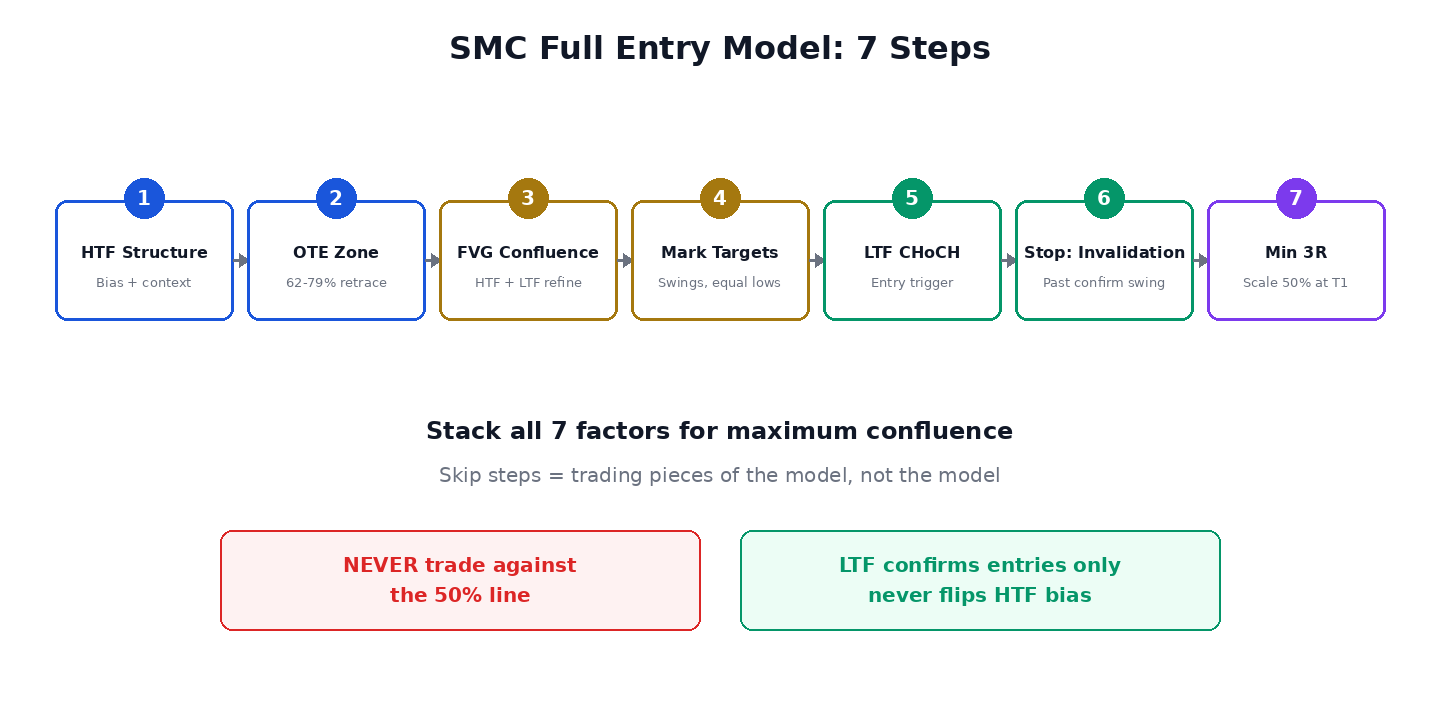
The same sequence as a model: bias first, zone second, trigger third, management last. Nothing enters before its turn.
The mindset shift: fewer decisions, same sequence
Here is the uncomfortable truth: every discretionary tweak you add to these four steps — the extra filter, the "gut feeling" override, the early entry — makes you less consistent, not more. A checklist only works if it is boring. The goal is not to be right about every trade; it is to take the same trade, the same way, one hundred times, and let the edge compound.
So stop collecting concepts. Start running the sequence. Your fifty-first video will not fix what a checklist fixes.
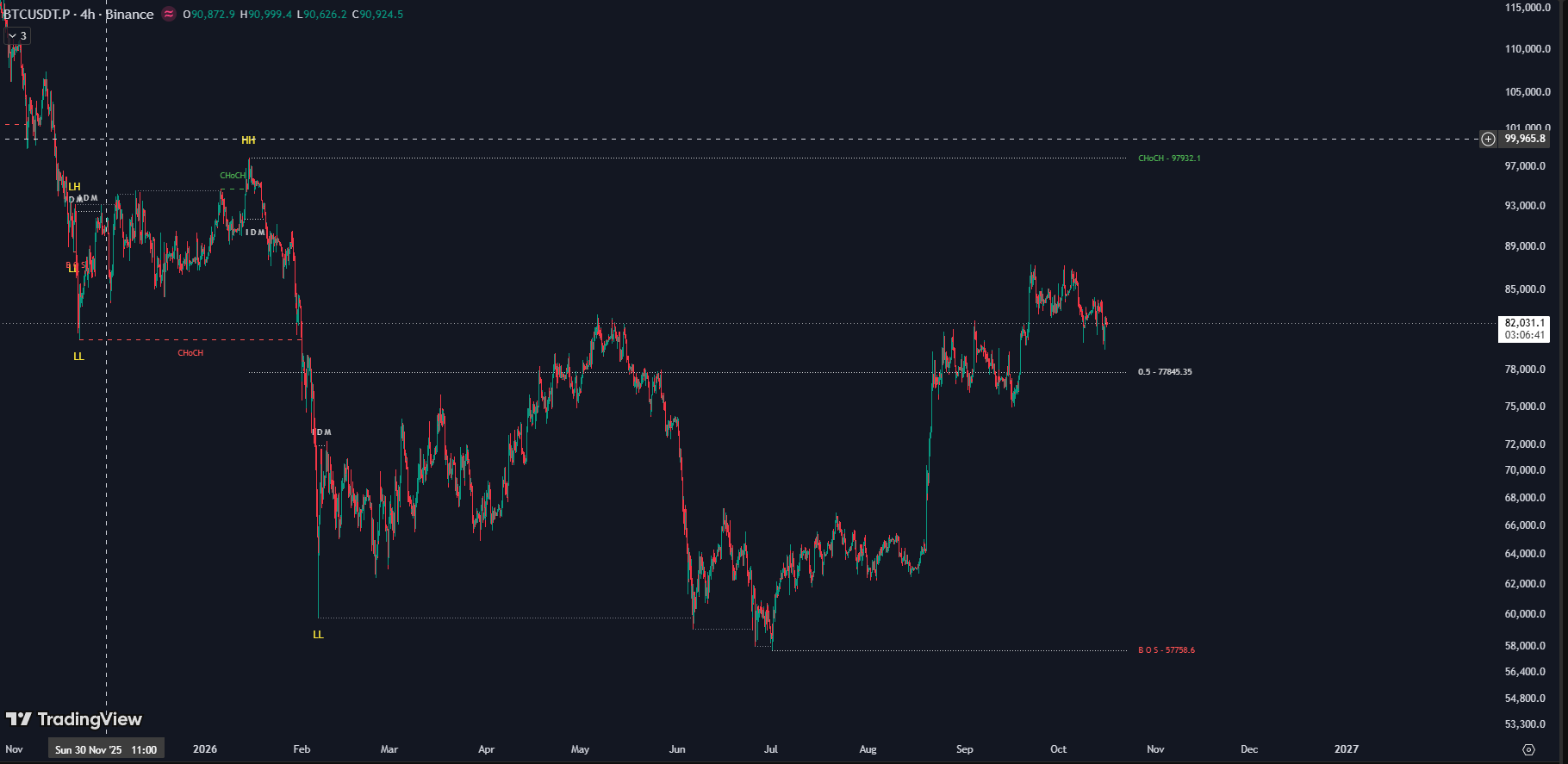
The checklist. On autopilot.
The full method behind this guide lives in the free 36-page Trading Hub 3.0 handbook — and JUKA runs the sequence for you live on any TradingView chart: structure, sweeps, zones, CHoCH triggers.
The complete Trading Hub 3.0 source code (Pine Script v5) — yours to own forever, $150 one-time.
Download the Free Ebook Get JUKA — $150