Trading Hub 3.0 (Part 4): What Is Order Flow and How to Enter Trades with OF – SMC
In the Smart Money Concepts method, Order Flow is the first step to identify a POI. A POI is a Point of Interest, a special area where we make the decision to buy and sell.
What is Order Flow (OF) in SMC?
Order Flow is the final buying effort before price falls in a bearish market, or the final selling effort before price rises in a bullish market.
Order Flow, Order Block, IFC… are different scenarios that we look for for Buy and Sell trades; we call these places POIs. Among them, Order Flow is the first element used to identify a POI.
In one move of price there can be many OFs. We also need to identify which OFs have been mitigated — the OFs that price turned back to tap into before returning to the previous trend.
Price needs to come back to mitigate at least one Order Flow before continuing the previous trend.
A simple way to identify OF
The main purpose of identifying Order Flow is to identify an Order Block (OB). An OB is essentially a more refined version of an OF.
You can identify an OF based on the LTF or the HTF or any timeframe. Looking for an entry based on OF will reduce the RR ratio because the stoploss of an OF is quite far from the entry, while the stoploss of an OB is much shorter.
However, we can still enter trades with OF instead of waiting for an OB. OF is the first signal and OB is only a more refined version of OF.
How to identify Order Flow
Bearish Order Flow
We need to identify what the current trend is. If the current trend is bearish, you can identify it by waiting for price to break through the previous low, then looking for the final buying move before price continues the downtrend.
Conditions to identify a Bearish OF:
- Price must break the previous low
- It must not be located inside a previous OF
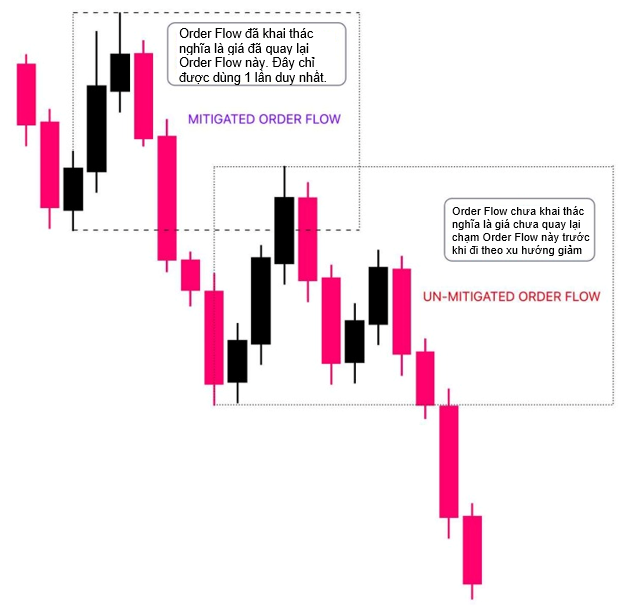 Identifying a Bearish Order Flow
Example of a Bearish OF:
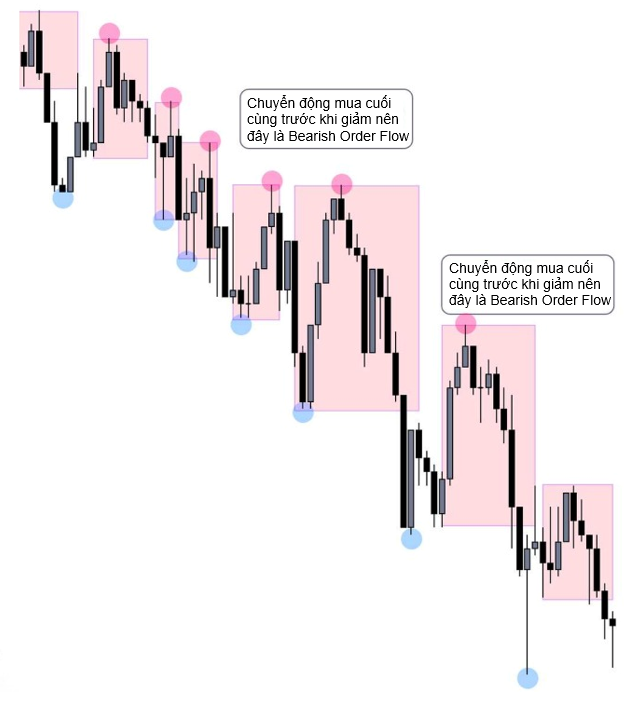 Example of a Bearish OF
Bullish Order Flow
If the market trend is bullish and price breaks through the previous high, we need to identify the final selling move before price continues the uptrend.
Conditions to identify a Bullish OF:
- Price must break the previous high
- It must not be located inside a previous OF
After identifying and marking the OF, we can switch to the LTF to look for an entry point according to the plan.
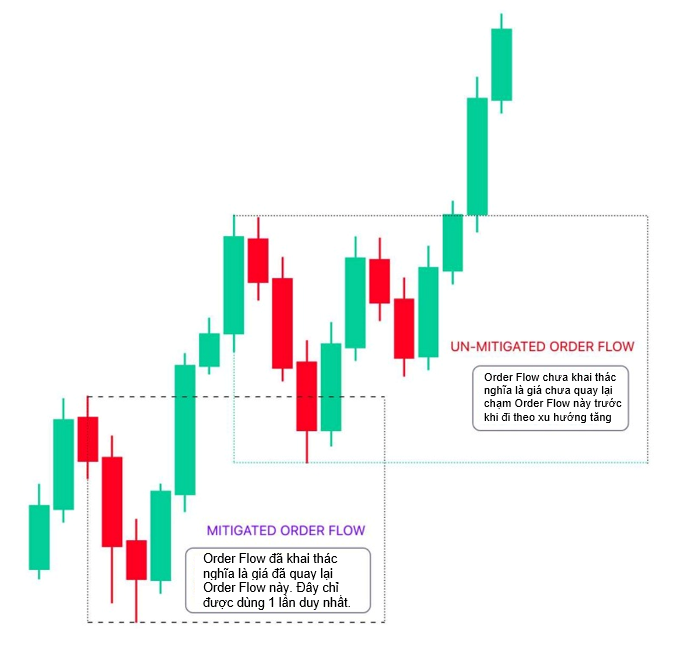 Identifying a Bullish Order Flow
Example of a Bullish OF:
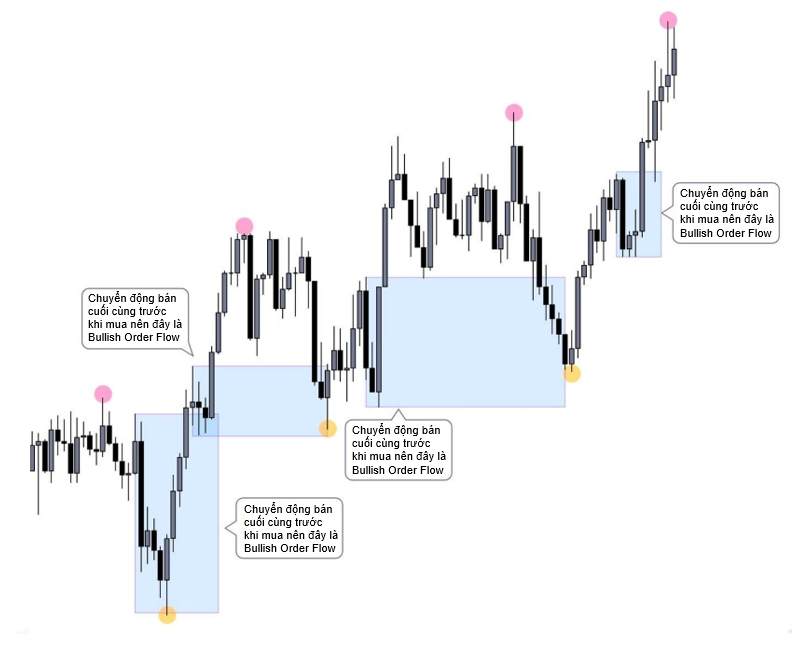 Example of a Bullish OF
Readers, please read again and watch the lesson's tutorial video many times to understand how to identify OF. In the next part of Trading Hub 3.0, we will learn about OB.
Note: if an OF is located inside a previous OF, we will not count it as a valid OF even if it has not been mitigated yet.
 Example of an invalid Order flow
  Example of a valid order flow
How to enter trades with Order Flow
There are three important things in SMC: first is structure, second is liquidity, and third is Order Flow. Entering trades with OF will have a higher probability than with OB.
Method 1: Enter directly with OF
We can enter directly in 2 scenarios:
- If price breaks structure (BOS), we need to wait for it to break through the IDM and tap into the OF to enter.
- If price has not broken structure yet, we can enter as soon as price comes back to tap into the OF.
 Entering directly with OF
However, if you enter directly like that, the RR ratio will be low because the width of an OF is usually very large. Refer to the method for entering with OF below to increase the RR ratio.
Method 2: Enter when OF appears at the LTF
The steps are as follows:
- Identify an unmitigated OF on the HTF.
- If price breaks structure, wait for price to break through the IDM and tap into the HTF OF, then switch the timeframe to the LTF to look for Order Flows located inside that HTF OF. If price has not broken structure yet, switch straight to the LTF to look for Order Flows located inside that HTF OF without needing an IDM.
- When price taps into these LTF OFs, we can enter directly (50/50 probability) or wait for the candle setup to create another OF, and when price taps into these OFs, enter the trade (high probability).
Let us look at the following example to understand this entry setup.
 Step 1: Find an unmitigated HTF OF
  Step 2: Switch to the LTF and find an unmitigated OF inside it
  Step 3: An OF appears, enter the trade — How to enter with high probability with Order Flow
So with the entry setup above, we will have 3 forms of OF appearing: the first form on the HTF is called the HTF OF, the second form after switching to the LTF is called the LTF OF, and the third form is created after price taps into the LTF OF, and we will enter when price comes back to mitigate OFs of this form (let us temporarily call this third form the "entry OFs").
Note: if many OFs appear at step 2, the first OF to appear is called the Decisional POI, meaning a POI with 50/50 probability. We should prioritise the last POI to appear, called the extreme OF (extreme POI), which will give a high probability of winning because all the OFs after it have been mitigated. The example above is one such case.
Bonus (for readers who have finished Part 5 - OB): what will we do when, at step 2, price breaks structure but there is no IDM? Trading Hub 3.0 will tell you a way to enter as follows:
- When price comes back to mitigate an HTF OF without an IDM even though there has been a BOS, we will look for an unmitigated OB on that same HTF. This method is based on the following thinking: because the width of an OF is very large, an IDM has not appeared before price taps the POI, but when we identify an OB instead of an OF, the width of the POI becomes smaller and an IDM is very likely to appear before price taps into the POI.
- After price breaks through the IDM and taps into the OB, we will start looking for an entry following OB or SCOB. See Part 5 - OB and Part 10 - SCOB to understand how to find an entry point.
 Entering with OF after a BOS but no IDM appears
5/5 - (2 votes)
Read structure 10x faster with JUKA
JUKA maps SMC structure — swings, BOS, CHoCH and inducement zones — automatically on any TradingView chart. No more hand-drawing structure for hours.
Get JUKA — $150